Why my favorite kinds of gematria involve a cipher nobody wrote, knobs to fiddle with, and how numbers mean anything at all.1
Three Words in a Dream
In May 2017, on a family holiday in a medieval town in Provence, a demon gave me three words in a dream. He was bald and his face was covered in scars, and with every word he spoke, the scars on his lips moved into the shape of it2:
GOD ANKHOR SOLEX
The first word needed no explaining. The second opened up two months later, on a walk with my daughter: Ankhor, "Horus lives". The third stayed a riddle. The only thing it brought to mind was a French moped3.
Two years later someone on Discord suggested gematria, so I spelled SOLEX in Greek: ΣΟΛΕΞ. It adds up to 365. A solar cycle counted in days. And the value of the great archon ΑΒΡΑΣΑΞ, Abrasax4. I'd been dabbling in isopsephy ever since I got into the PGM5. And for two years I had been carrying a god's number around without knowing it.
I kept that word as my online handle NN_Solex and for a while it was even the name under the posts on this blog, until I folded everything into T. F.
So who matched SOLEX to 365? Not me, that's for sure. Or did I? In The Formula Bar I explored how anything gets tied to a god, but numbers? Who ties a thing to a number?
Assignments
I had known about gematria since I can think6. In this ancient art meaning is put into the numbers on purpose and words with matching numbers are meant to correlate. The name Abrasax was built to match the days of the year, and the PGM are explicit about the numbers of names: one spell asks for "your most great name, of which the number is 9999"5. Gematria reseacher and writer Bethsheba Ashe makes the strongest case that the scribes of the Old Testament did the same. In The Genesis Wheel she works through the gematria of every single word of the first two chapters of Genesis, "no cherry picking here!", and argues that the creation story was built on an alphabetic framework from the start7. A bold claim, but she does the rigorous counting to back it.
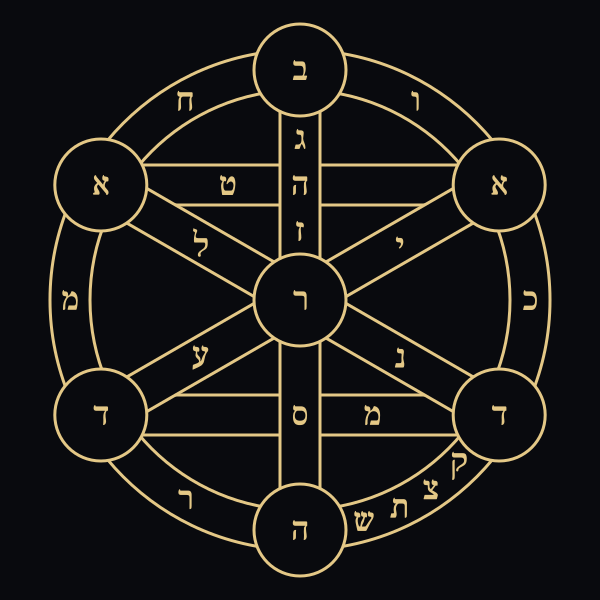
So behind every one of these numbers stands someone who deliberately used it as a code. There's another kind of number that means nothing at all but works as a code too, because someone tied it to a specific thing.
That kind of number came into my practice with the art of psionics, culminating in the creation of the Psithemius, an electronic device that acts as a table of practice I built in 2020. It has a jack at the back for any psionic or radionic machine. Mine was a Berkana Labs box8, plus a few earlier gadgets I built myself. In this practice intents are encoded on sets of dials using so-called rates. That's radionics' word for the numbers on the dials, and Charles Cosimano, the self-declared Archfiend of American psionics, puts it as bluntly as he puts everything:
The rate is simply what the numbers on the dials say when they are set. It is nothing more than an expression of the relationship between your mind and, in this case, the thoughtform you will be working with.9
Setting the dials "locks in that relationship and frees the mind of the operator to do other tasks"9. For other Radionics practitioners rates are considered a frequency, and many of their boxes are modified radios. "There was only one little problem", Cosimano says in his very first YouTube video. "The machines worked if they weren't plugged in."10 That's why his infamous devices that usually consist of a cardboard box with dials cut out of poster board "work very well that way because all you are doing is setting up relationships in your consciousness"9.
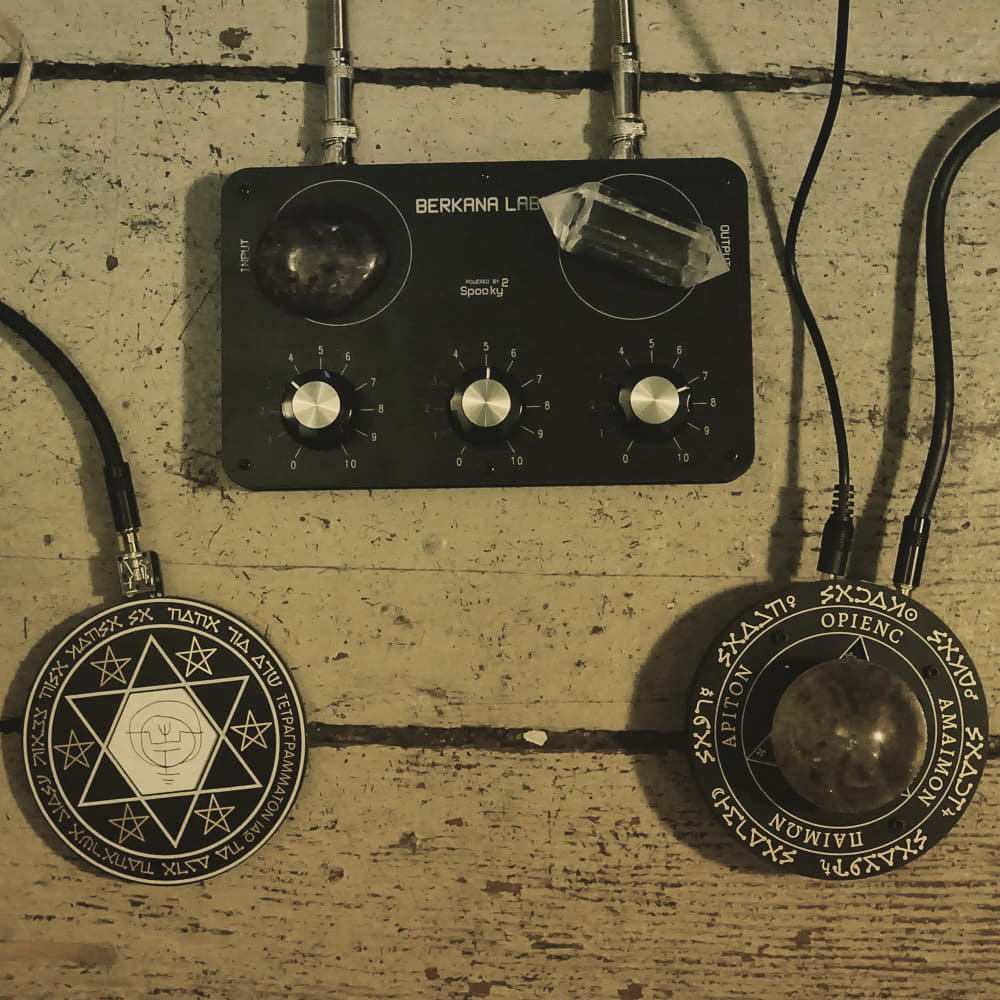
So the box is less of a transmitter and more of a bookmark. The rate is a relation with a number on it, and the dials hold it for you so that you can stop holding it in your head. Cosimano says it himself in one of his late-night videos: "What matters is how well the operator relates to their machine, and that is all that matters."11
Traditionally these numbers come from a rate book: decades of practitioners' collected findings. The Combe rate book, for example, lists ABANDONMENT as 12233, and gives every entry in three different bases12. There's nothing in 12233 that spells abandonment, of course. Someone tied the two together.
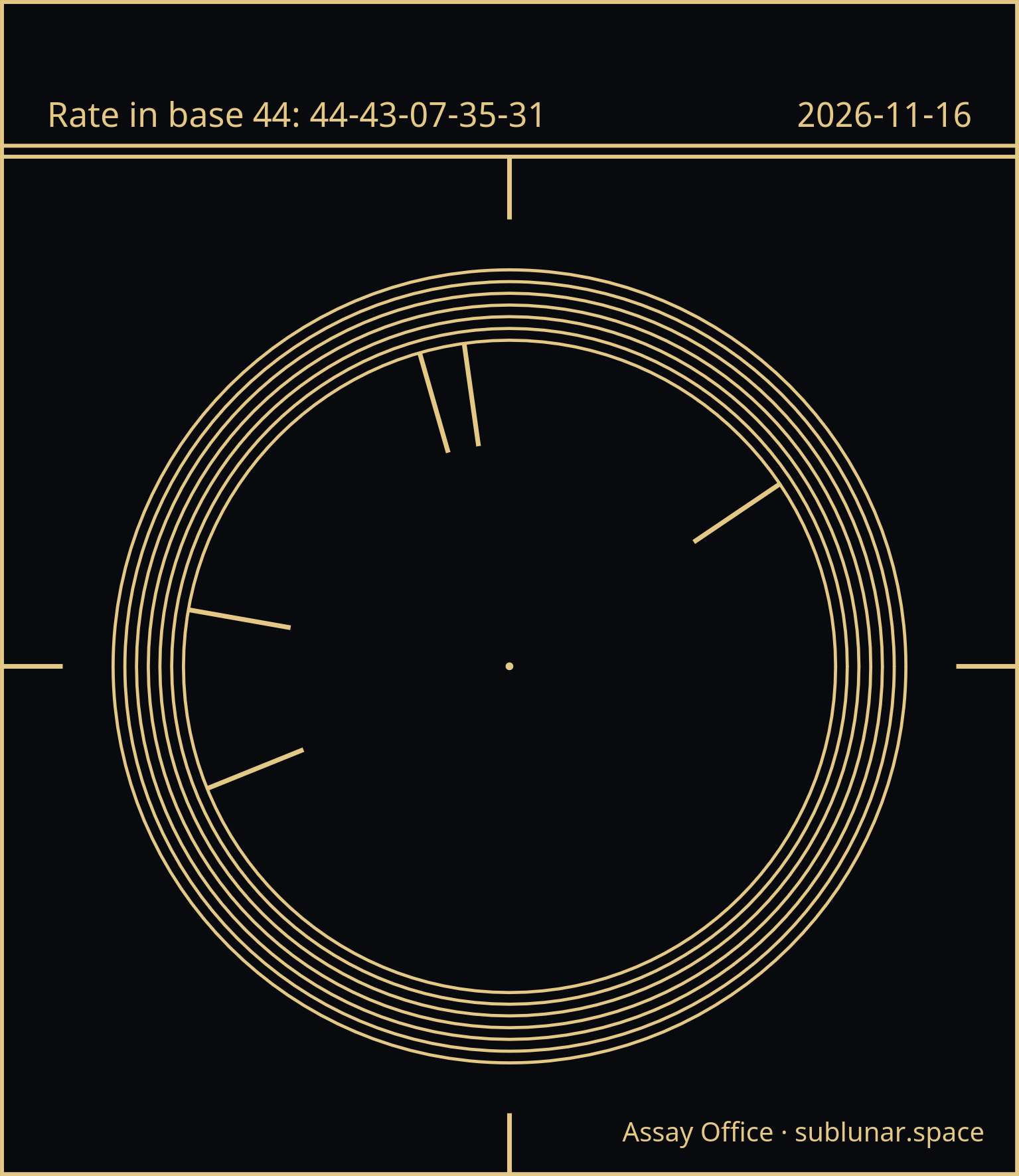
The rates don't even have to stay numbers. Malcolm Rae got rid of the dials altogether and turned numbers into angles. He encodes his base 44 rate into steps of 8°, and each number is drawn as a short line pointing inward from a ring of seven circles13 on a paper card. Cosimano would have said the numbers had been angles all along: what counts on a dial is "the relationship of that little circle inside the potentiometer as it is tuned to the entire circle"10. And something else happens to the number on the way: a card has no first or second line, only directions, so 12-03 and 03-12 result in the same picture. A rate drawn like that has stopped being a number sequence and become a shape. That's halfway to a sigil. We'll get to that in detail in another article.
The strangest rates, though, came from the military. The Coordinate Remote Viewing manual, written in the 1980s for the US military's remote viewing unit, gave the viewer nothing but geographic coordinates "for cueing or prompting" an image of the place in their mind. Repeating the coordinate, the manual says, "is the mechanism which 'evokes' the signal line", and it glosses evoke as "to call forth or up; to summon"14. Later practice dropped the coordinates for target reference numbers that have nothing to do with the target at all. The "tasker" picks a target, a photograph, a person, a document or a place, and simply "assigns it a number"15 for the viewer to work with. The manual's authors thought the information came from a "Matrix", "In the same vein as Jung's Cosmic Unconsciousness". I would turn that around: I don't think the number reaches up into some universal mind. It ties the viewer to whatever the tasker tied it to, exactly the way a rate ties the psionic supervillain to a thoughtform.
Votes Count
Radionics also offers another way: to take the rate yourself and let your body decide where the dial stops. You can use a pendulum, or a stick pad: a small plate on the box that you stroke with a fingertip while you slowly turn the dial with the other hand. Where the finger "sticks", the dial stays. The idea is that the hand finds the number before the head can get in the way.
I have a generally weak interoceptive sense and my hyperactive head is always in the way. On the devices I have experimented with I tried both, stick pad and pendulum, and to be honest, neither never really worked for me. Even Cosimano admitted he didn't use the stick pad very often16. My solution was to hand the decision down to a crowd much further below, to a random number generator. Its stream of bits was cut into chunks of which some moved a dial one step to the left or the right and others voted when to stop the dial where it stood. The random method, by the way, is the oldest sense of sorcery. The Latin sors is the lot, and a sortiarius was someone who cast lots.
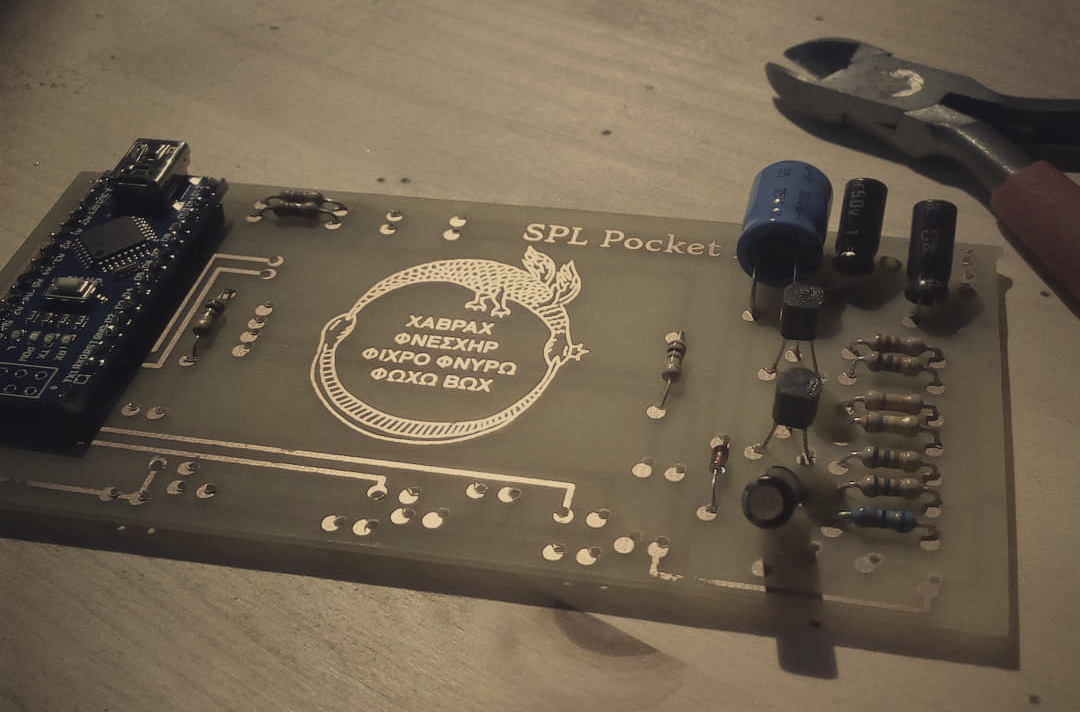
Although I let randomness pick the numbers I'm still in the picture. I triggered the process and decided to use the result. The crowd voted, but I called the vote. To take the author out of the number-tying completely, you would need a number that was already there before anyone went looking...
A Hidden Cipher
Numbers didn't start out as numbers. The archaeologist Denise Schmandt-Besserat spent decades on the clay tokens and tablets of the ancient Near East, and she found that the oldest numerals we have, on the tablets of Uruk, were borrowed:
[They] were not symbols specifically created in order to represent abstract numbers. Instead, they were the impressed signs, formerly indicating measures of grain, endowed with a new numerical value.34
A sign that used to mean a measure of grain was made to mean a number. The Greeks and the Hebrews later did the same thing with their letters.
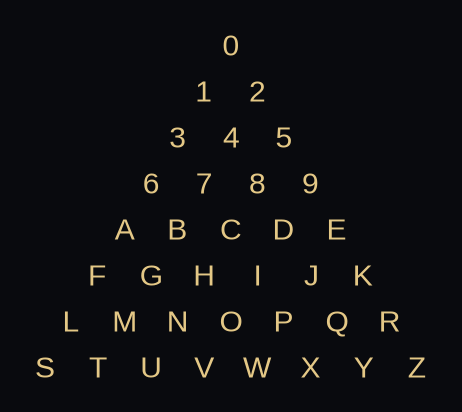
Computers did it too. When programmers needed more than ten signs to represent numbers without having to add more digits, they simply kept going into the alphabet after 9. Hexadecimal stops at F for 15 and base-36 uses all of it, A for 10 up to Z for 35. As early as 1989, Vilém Flusser saw where this was heading. A media philosopher from Prague, he had fled the Nazis to Brazil and spent his last decades thinking about what codes do to us. Looking at the typewriter keyboard, letters and digits side by side, he wrote, almost as a threat: "As for letters—if they want to survive—they have to simulate numbers."17
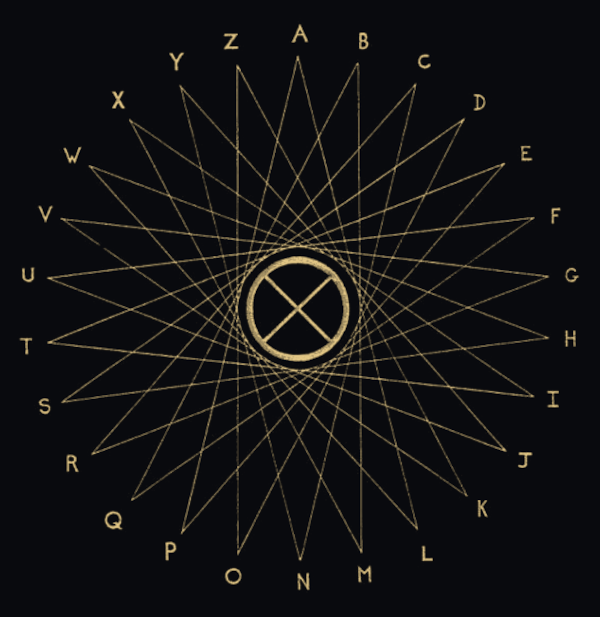
Add up the letters of an English phrase by their base-36 values and you get Anglossic Qabbala, or AQ. I first ran into it in 2017, in Reza Negarestani's Cyclonopedia, the theory-fiction where crude oil is a demon. Every entry in its glossary carries an AQ value: OIL is 63, and DUST is 100, the same as NO GOD18. The earliest version I could find is in the 1999 glossary of the Cybernetic Culture Research Unit, and it already comes with the match that made it famous: the Law of Thelema, "Do what thou wilt shall be the whole of the Law", adds up to 77719.
Later Nick Land, CCRU co-founder and godfather of accelerationism, credited the cipher to "August Barrow", an 18th-century occultist from the CCRU's own mythology20. In the same essay Land describes the whole history of qabbala as an accident of notation, a "semiotic glitch" that, "lacking the authority of tradition or even purpose", was "compelled to hyperstitionally generate an extreme antiquity for itself". I've already ranted about that when I chopped down the Numogram. Point is: they made one up for AQ, too. Barrow is a fake antiquity built by hand. Kurt Gödel, of all people, said it about fraud in the paranormal: "the sense of the fraud is … not that it simulates, but that it masks, the genuine phenomena"21.
What's way more mindblowing than a fictional author is that the cipher itself, has no author. No one wrote English to fit base-36. English spelling came out of centuries of scribes, printers and accidents, and base-36 came out of engineering. So when two phrases meet at the same number in AQ, there's no kabbalist who meant them to, and no tasker who tied them together. That's exactly why I've used it for years, and why I promised it its own article. Here it is.
Mining Numbers
Spring 2021 was peak pandemic, and the chaos ran on two engines: hyperstition, fictions making themselves real, and hypostition, facts being recast as fiction. Everything felt up for grabs, our lives included. Trying to not catch the virus I stayed home at the time, deep in Numogram material, and AQ was how I stayed sane. I scanned news items and medical brochures and counted them against Dune, Machiavelli's Prince and whatever phrases I had collected so far. Nothing made sense anymore, so I surfed that wave with fever fueled numbo jumbo.
I wanted better tools for it so I added AQ to my fork of Gematro, an open-source gematria calculator22, and in May I wrote a Telegram bot around it, inspired by the AQutie bot on the Deadlines Discord, a numogrammatic nerd hangout. It counted in four ciphers, from AQ to Hebrew gematria, Greek isopsephy and Arabic abjad, and came with libraries to match against: the Urbanomic Nummificator, Homer, the Poimandres, the books of Moses. I named its presets after people: nick, lillian, moses, betsheba, hermes, aleister.
Then, in the beginning of June, a stranger wrote me a PM. He was Luís Gonçalves, who writes as Alektryon on Gematria Research, and he asked whether I was the one who'd been using AQ on Thelema. I wasn't. To be honest, I never cared about Thelema. He had mixed me up with someone else and still came to the right person: he brought a list of Thelemic values he'd found, and a bug report. My fork had the digits in its cipher table, so any number typed into it got counted twice, once as a number and once digit by digit. His example was 365. The calculator said 379.
So he had written to NN_Solex, whose name was 365, about a calculator that couldn't count 365.
And it gets better. That conversation started 36 days after the fork, and AQ is a cipher of 36 characters, 0 to Z. He noticed that, and plenty of other 36 after it, and wrote them up on his blog. A year later, to the day, I pointed out that we'd first talked exactly 36 decans ago.
Brought together by a cipher we ended up trading finds for years, mostly about the decans, which are another obsession of mine, and the Numogram. In 2022 one of those conversations made me promise myself the piece that became Machinic Dendrophiles, just three years later. By 2025 we had both left the Numogram behind and kept AQ. Our roles haven't changed since: he's the generous researcher who starts things, and I'm the critical friend who tends to drift off but always comes back.
My own AQ library didn't survive. It grew out of the bot's corpora, phrase by phrase, until 2022, when something got into my old server, probably through a hole in WordPress. Malware everywhere, a corrupted database, rogue bitcoin miners. Machines mining numbers out of the machine I had built to count words. I had to wipe the whole thing clean, and everything went with it. Back to zero.
What Coincidence Is Made Of
Let's get the honest part out of the way first: in AQ, coincidences are cheap. The values of short English phrases cluster in the low hundreds, and the language has far more phrases than there are numbers to go round. The word list my bot used, about 86,000 English words, fits onto just four hundred values. A single number, 126, holds 651 of them. In Urbanomics' original Nummificator the same 126 is AIWASS and HORUS, which any Thelemite will enjoy, and also HITLER23, which nobody should. The British number theorist Richard Guy called this the strong law of small numbers: "There aren't enough small numbers to meet the many demands made of them."24 Cicero put it more bluntly two thousand years earlier, about prophetic dreams: "who, if he shoots at a mark all day long, will not occasionally hit it?"25
So chance explains the supply but it doesn't explain the delivery. Back to the 365: the base rate tells me that 365 has company in every cipher. What it doesn't tell me is why my first conversation with the person who'd become my AQ friend turned on 365, addressed to a name that was 365, through a bug in the very tool that brought us together. Chance makes matches cheap, sure. But it says nothing about which one reaches whom, when, and along which bond.
There's an old answer to the delivery question: "someone sent it". Allen Greenfield, the American Thelemite and UFO occultist, gave that answer its wildest form in Secret Cipher of the UFOnauts (1994). He ran the names that contactees brought back from their space brothers through the English Qabalah, a cipher drawn from the grid on a manuscript page of Crowley's Book of the Law, and found them encoded. In that cipher LAM, the being Crowley once drew, equals GOD. For Greenfield the contactees' messages are "like the old alchemical ciphers", meant to be "truly understood only by deep initiates in possession of the code", while those without the key "can only remark of the coincidence"26. Every match is a message somebody sent. And that's where it gets tricky. With a sender you can never be wrong: a hit is his message, and a miss just means you haven't cracked his code yet.
The English writer Patrick Harpur, who probably spent more time in these rabbit holes than most of us, knows the condition well. "The paranoiac always sees a hidden (but often menacing) order behind the phenomenal world", he writes, and then turns it on the other side: "Thus it may be that our modern preoccupation with cause and effect is a touch paranoid."27 The believer insists on a sender, the sceptic insists on a cause. Neither of them can stand a coincidence that's just there.
A newer answer comes from a physicist who got himself entangled in numbo jumbo too. Philippe Guillemant, a researcher at the French CNRS who works on chaos and artificial vision, has the most stubborn number story I know. When he founded his company on the 22nd of December, his business partner, who was into numerology, told him that 22 was also his "path of life", worked out from his name. So he started "sowing" it: in passwords, in the lottery, "I even went so far as to do 22 press-ups in the morning instead of 20". And 22 came back. 11:22 on the clock, page 22 in a book, a bill of 22 euros and 22 cents for his first dinner in a new flat. On the day he signed for the land he'd long been looking for, the trip counter read 22.0 km just as he reached the RD22, and the book he bought while waiting for the solicitor cost 22.90 euros, from a publisher at number 22. "This quadruple 22 reduced my scepticism to zero." And then the house itself turned out to be 22 metres wide, with a hot spring in its grounds at 22°28.
His explanation: time travel! The intention "feeding" possible futures, and information flowing back from them, even into hist past: his natal Sun at 22.44°.
I don't buy the time travel bit. But look at the shape of his story, because it's the same shape as this article's: it starts with a number assigned at will, handed to him by a numerologist. He would then feed the number on purpose, until they eventually came back to him from things nobody could have arranged. They were simply there. Guillemant even draws the line himself: a coincidence can be noticed before anyone means anything by it, a synchronicity only after an intention has gone out.
He also found a way out of the sender problem. If any hit can be a message, you end up watching for signs all day. So he gave his question to his guardian angel along with an appointment:
When the clock on my car reaches 191191 km, a number corresponding to my children's dates of birth, send me some signs.
The signs did come, but putting it that way, he writes, "had the advantage of stopping me from constantly watching out for signs of an answer"29. Everything else could go back to being a coincidence that's just there.
That's the bookmark again. In the late-night video quoted above, Cosimano tells the story of a doctor who didn't even use a radionic box: he wrote the rates on a piece of paper, "and that's it", and "lets it go"11. The number holds the intent, so that you can let go of it.
I don't look for a meaning in the cipher anymore, or for a sender behind it. What's way more interesting is the web a match travels through. Harpur says it about crop circles, and it's just as true for numbers: "Like most daimons, they do not bear messages — they are themselves the message."30
Into the Rabbit Hole
Whether you nodded along with this winding treatise on numbers, or disagreed, whether you believe in ufonaut cabals or none of it, doesn't really matter. If you want to try any of this yourself, here's a short guide on how I usually go about it and a tool to use.
I took some of my improvised scripts, psionic algorithms, and the remains of the numogram Telegram bot and threw them at Claude to clean them up and help me condense them into one intuitive tool, the Assay Office: AQ and a set of dictionaries to count against, room for your own, and optional psionic dials that take a rate by chance.
I. Finding Correspondences
- Type something into the search bar: names, words from dreams, lines that stuck, the title of a song or book you love, anything really.
- The tool will immediately show you its AQ number above, and all of its neighbours below. A number in the low hundreds can have hundreds of them. The question isn't if there's a match, it's which one stops you. Let that happen before you start explaining it, the way a stick pad lets the hand decide before the head does.
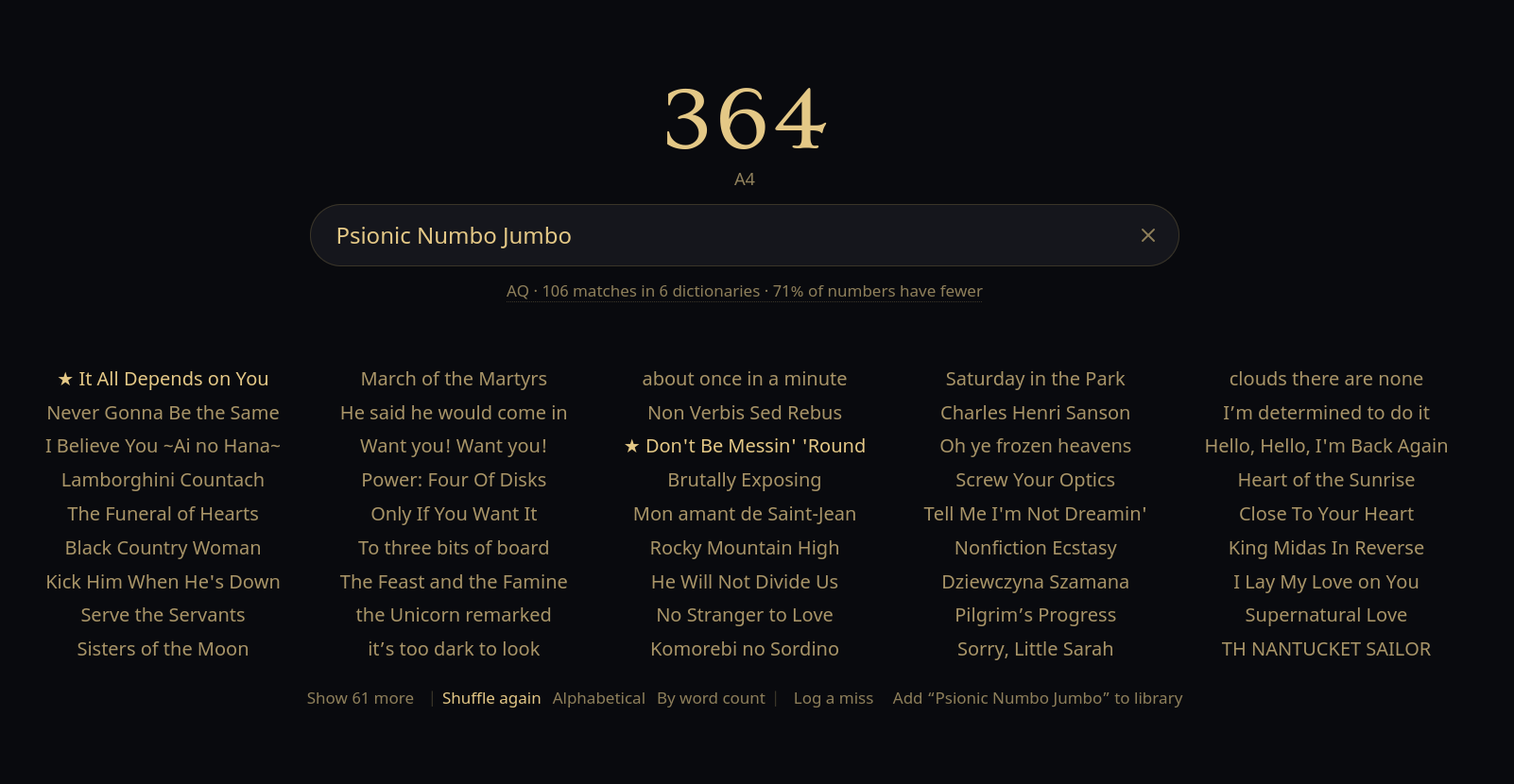
- Click the ones that stop you and they get automatically added to a log together with a timestamp and the value (see the Log link at the top right). There's also a button that lets you log misses, because if nothing stops you, that's also a find. Misses are what make the strange ones stand out.
- Hover over an entry to see its source.
- Anything you enter can also be stored in the Library so you can grow your own on top of the default corpora. You can even bulk import line separated lists of phrases. The personal layer matters most, because coincidences gather where you live.
- Explore the Settings behind the cog wheel at the top right. Here you can choose which of the libraries to include in the neighbour matching, and export a backup of everything you added. Everything is stored only in your browser, so keep the backup somewhere safe. Bots ate mine.
What to do with them? I don't know, dude. Follow where something points. Jean Shinoda Bolen calls Hermes the god of coincidence and warns that "People miss Hermes if their minds are set on a particular itinerary and schedule"31. Let your own correspondences grow out of the matches that keep coming back, instead of adopting someone else's table. A match that keeps returning can name a working, open a rite, or end up on a sigil. Try it with a friend: swap phrases and log what crosses between you. That's how the 365 found me, after all.
If you want a more advanced tool and go down the rabbit holes of ciphers other than AQ, I recommend the improved successor to Gematro at cyphers.news.
II. Numbers as Sigils
Assay Office also has an optional secondary function as a virtual psionic device. It works like this:
- Write an intent as one sentence. Its AQ value is its base rate.
- Check the company: look up everything else at that number. If the neighbours are wrong, rephrase until the company fits, because you're inviting all of them.
- Tap the Dial a rate tab at the bottom center of the screen and the psionic device opens. You will see the base AQ rate already pre-set on the dials. At the top you can choose between three traditional radionics rate systems: base-10, base-44, and base-360.
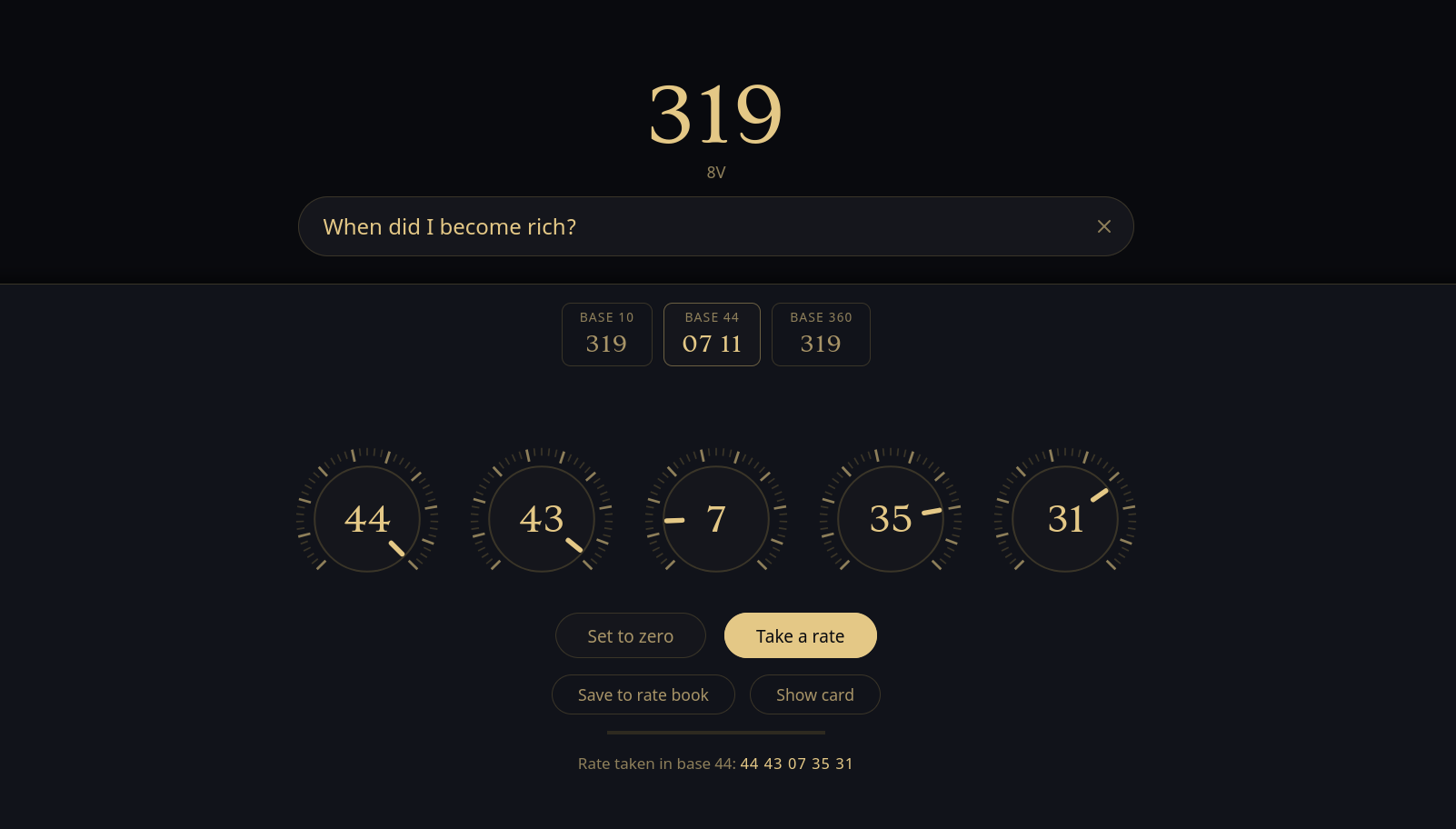
- You can use the rate as it is. But the real fun begins when you let chance take a rate for you: tap Take a rate and watch how randomness collected from your device's CPU and sound card turns one dial after the other. That randomness is the crowd below assigning your intent its rate, the way a remote viewing tasker assigns a target its number.
- You can store it in your Rate Book with the click of a button below and optionally give it a return date. That's the date to check back in to see if your intent came to fruition or not. The Rate Book will hide your intent until that day, so you don't accidentally remember it. Let go. The dial holds the relation so you don't have to. Don't keep checking on it: a working you keep testing tends to dry up35.
- You can also print it as a Rae-style card: the Assay Office draws one for you, with or without the intent written on it. Use it as you would use any other sigil in your practice.
- The cog in the Dial a rate panel lets you tweak the device: the number of dials, a custom base, the stop threshold. Tinker with them.
- If you have your own psionic device, dial the rate in on it and let it do the work instead. It's your relationship with the device that makes it work.
III. Stepping Back
The real risk isn't being fooled, it's getting caught in the loop. A cipher that keeps answering can swallow everything else. Remember that numbers are just numbers. There are plenty of charts and diagrams out there that will tell you what they mean. This is exactly what the parapsychologist George Hansen means when he warns that
rigid structures of thought, behavior, and belief all conspire to reduce magic, suppress the trickster, and marginalize the paranormal36.
Greenfield shows the full-grown version, with a sender behind every match. And Harpur tells the story of John Keel, who fled New York because UFO entities and trance mediums had predicted a disaster that never came: "He had been had." The messages, Harpur says, "should no more be taken literally than these entities themselves"32.
So set an end date. Keep the return. And when a cipher starts to feel like the whole world, put it down for a while or put it down for good: bury it. I'm serious. Numerology is known to have a tendency to drive people mad.

Learning to Count
No one meant it ain't the same as nothing happening. AQ has no scribe, so a match can't be anyone's code. Chance explains the supply, not the delivery. Picking a match up is participation in the web. That's what the practice above is for: the reader is the last co-author a coincidence needs.
Luís, who tried Greenfield's method on AQ, but without buying his conclusions, put it best: "No matter the cipher: there will always be some synchronicities that seem to be more than synchronicities."
Those who claim that we are about to shatter to bits that sorry scheme of things entire are perhaps unable to see that we may be able to compute it nearer to the heart's desire. It is time for those people to learn how to count.
— Vilém Flusser, "Discovery" (1989)
RIP Uncle Chuckie
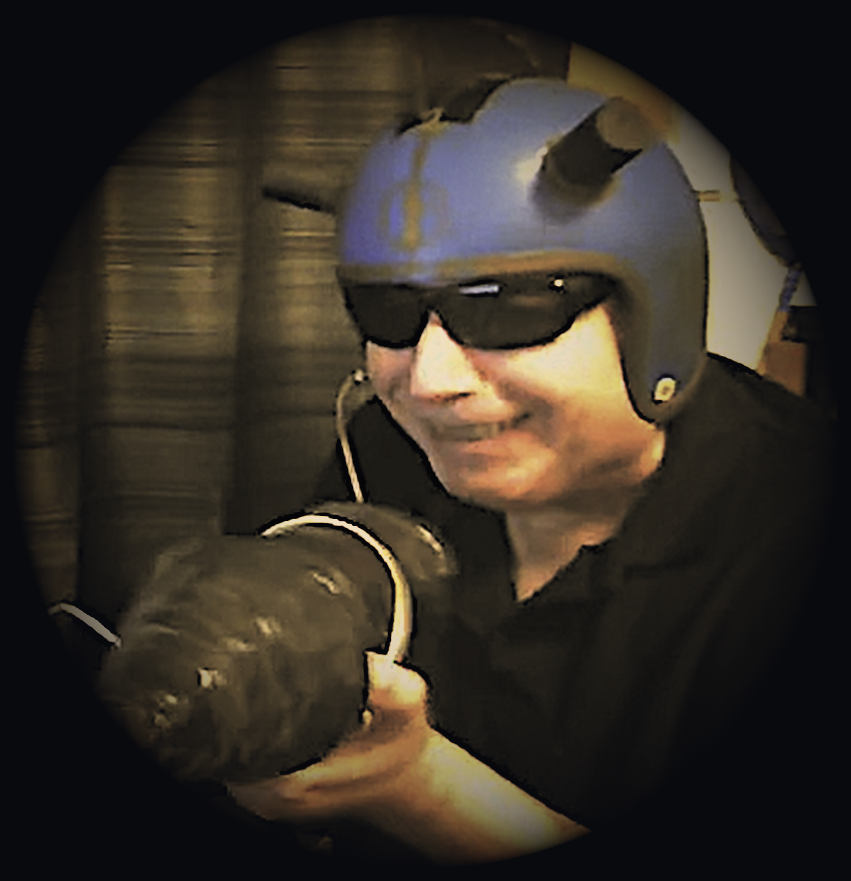
While checking citations for this article, I learned that Charles Cosimano died on 10 January 2026. He built his first radionics box on 7 April 1977, after reading an article on "electronic talismans" in Llewellyn's Gnostica33, and he spent the next fifty years showing that psionics needs no more than cardboard, a pendulum and a bit of nerve. From 2006 he did it on YouTube, one of the first in the occult world to do so, introducing himself as "your great, wise and evil Uncle Chuckie" and signing off with "have an evil day". He was a giant of the psionic scene: a self-declared Archfiend, highly controversial and politically problematic. Above all, he was a great teacher with an unerring nose for bullshit, who always cut through the crap to what matters. The way this article thinks about a rate, as a relationship with a number on it, is his. The world might be a safer place without Chuckie, but he will be missed.
-
ars numerandi = AQ 245 = the odds shift = a law of nature = a curious fact = beyond reason = an intuition = and sympathy = God and his ideas = World of many = blades of grass = a plant grows = occult world = literally odd = terrible evil = a beautiful day = when to stop = a better title. ↩
-
Ochre Archons. I wrote the second word down as ANCHOR at first; the blur between anchor, archon and ankhor is part of the story. ↩
-
PGM II 127, discussed in The Six Names. On isopsephy in antiquity, Kieren Barry, The Greek Qabalah: Alphabetic Mysticism and Numerology in the Ancient World (1999). ↩↩
-
Neither Greek nor Hebrew had separate digits: the letters were the numerals, in Greek from alpha = 1 to omega = 800 (with three archaic letters kept for 6, 90 and 900), in Hebrew from aleph = 1 to tav = 400. So every word is also a sum. Isopsephy means "equal pebbles": two words that weigh the same on the counting board. ↩
-
Bethsheba Ashe, The Genesis Wheel: and other hermeneutical essays; see her gematria archive. She also wrote the Shematria calculator. ↩
-
Spooky² Radionics v1.2, Berkana Labs. ↩
-
Charles Cosimano, "psionics part 3", YouTube. ↩↩
-
Charles Cosimano, "the controversy over radionics devices", YouTube, 29 December 2014. ↩↩
-
Combe Rates (base 10, base 44, base 336). ↩
-
Malcolm Rae (1913–1979), Commander in the Royal Navy during the Second World War; the 2024 spec calls him "a British Electronic Engineer". The card geometry as given in "Radionics Basic Instrument Design", v6 (2024), psychotronics.org, section "Magneto-Geometric Cards"; the dowsing story in MGA-Rae information, after a talk by Margaret Belsham, who worked with Rae from 1958 until his death. Rae's own writings aren't online. ↩
-
Coordinate Remote Viewing (SRI International / DIA training manual, after Ingo Swann; ed. with an introduction by Paul H. Smith). ↩
-
"Glossary of Terms", the US military's remote viewing programme (Star Gate), CIA-RDP96-00789R003300210004-9, approved for release 2000 (mirror: The Black Vault) ↩
-
Charles Cosimano, "Zapping an annoyance", YouTube, 18 October 2017: "let's use the stick pad, I don't do this very often, but sometimes it's good for people to see". ↩
-
Vilém Flusser, "Discovery", Artforum 27, no. 7 (March 1989), pp. 10–12. ↩
-
Reza Negarestani, Cyclonopedia: Complicity with Anonymous Materials (2008); see Inorganic Demons. ↩
-
Ccru, "Glossary", Abstract Culture: Digital Hyperstition (1999), p. 64. ↩
-
Nick Land, "Qabbala 101", Collapse I (2007), pp. 274–75 and n. 4; the blog version is on the Hyperstition blog (2004). ↩
-
Quoted as the epigraph to chapter 20 of George P. Hansen, The Trickster and the Paranormal (2001). ↩
-
Gematro has had a stormy life. It has vanished and come back more than once, and its project page now carries a termination notice (October 2026) that declares even the forks "unauthorized", which is a lot to ask of code that was released under an open-source licence. My own fork is long gone. ↩
-
Playing around with AQ on German nazi phrases I also discovered a literally odd coincidence: NSDAP = 99, nationalsozialistisch = 444, and Nationalsozialistische Deutsche Arbeiterpartei = 888 ↩
-
Richard K. Guy, "The Strong Law of Small Numbers", The American Mathematical Monthly 95, no. 8 (1988), pp. 697–712. His one theorem: "You can't tell by looking." ↩
-
Cicero, De Divinatione II.121, trans. W. A. Falconer (Loeb, 1938), as quoted in Sharon Hewitt Rawlette, The Source and Significance of Coincidences (2019), ch. 1. ↩
-
Allen H. Greenfield, Secret Cipher of the UFOnauts (IllumiNet Press, 1994; digital edition 2005), ch. 3, pp. 23–24. ↩
-
Patrick Harpur, Daimonic Reality (1994), ch. 7. ↩
-
Philippe Guillemant, The Road of Time (2013), trans. Elinor Dorday, ch. XV, "The double 22". He says he changed the geological details of the quadruple 22 "somewhat, but it is entirely equivalent to the original". On coincidence and synchronicity: "observation of coincidence could precede intention", while in a synchronicity "observation always came after the intention" (same chapter). ↩
-
Guillemant, The Road of Time, ch. XIII, "Talking with Angels". ↩
-
Harpur, Daimonic Reality, ch. 12, on crop circles. ↩
-
Jean Shinoda Bolen, Gods in Everyman (1989), quoted in Hansen, The Trickster and the Paranormal, ch. 2. ↩
-
Harpur, Daimonic Reality, on John Keel. ↩
-
Charles Cosimano, "psionics part 2" and "The Story of the Helmet" (2020), YouTube. ↩
-
Denise Schmandt-Besserat, How Writing Came About (1996), ch. 7. Her larger argument is that writing grew out of counting, not the other way round. ↩
-
That's the decline effect. Walter von Lucadou, Hartmann Römer and Harald Walach read synchronicities as correlations that "cannot be used for transmitting signals or controllable causal influences", and derive from that why replication will "wipe out the primarily observed effect", and why effects "disappear, where they are sought for and to surface at some other unexpected place": "Synchronistic Phenomena as Entanglement Correlations in Generalized Quantum Theory", Journal of Consciousness Studies 14, no. 4 (2007), pp. 50–74. On that reading it's also why radionics keeps failing blind trials: a test treats the working as a signal. ↩
-
Hansen, The Trickster and the Paranormal, ch. 8, on Weber, charisma and disenchantment. ↩
Comments