How do things come to belong to a planet's series? And why is a table a memory, not a law?
Off-Label
For Jupiter I still raised a glass by the book. At my first planetary initiation, the libation was "a glass of my favorite Scotch Whisky Glenmorangie"1, which is exactly what Rufus Opus asks for: your best single malt.
After that it went downhill, at least by the book's standards. RO lists drink options for every planet, but there was never enough variety of alcohol at home, and the tea was just....tea. So for every sphere after Jupiter I was badly prepared and had to improvise.
The boldest substitute was for Selene. In early 2021 I briefly lived in a row of caves carved into the basalt in the rural south of Tenerife2. I did the initiation in a rush, with about fifteen minutes of preparation, and the libation was water from the tap! RO suggests absinthe, mead or a white wine with a hint of apple or pear, and he ends the libation with one more instruction: "If it's alcoholic, ignite it"3. Try that with tap water...
But to be fair, it was the tap of a cave house in the middle of nowhere, so the water came straight from a source in the rock. I had even gone looking for where it came from, and on the hill above the house I found one of the island's galerías, the tunnels dug into the mountains to get to the water inside them. For the incense I had the local incienso, a wormwood that grows all over that part of the island. Neither of them is in RO's book. Both felt right.
The question this article tries to answer is: if tap water can be the Moon's, what makes anything the Moon's? Where does a correspondence live?
Of course the clearest lesson came from Saturn, a year earlier on the same island. I told it in Canary Capricorn: a burnt pine whose branch came down crooked like a sickle, a hedge of morning glory, a crow made of plastic trash, and a rite in a galería shaft in the forest.
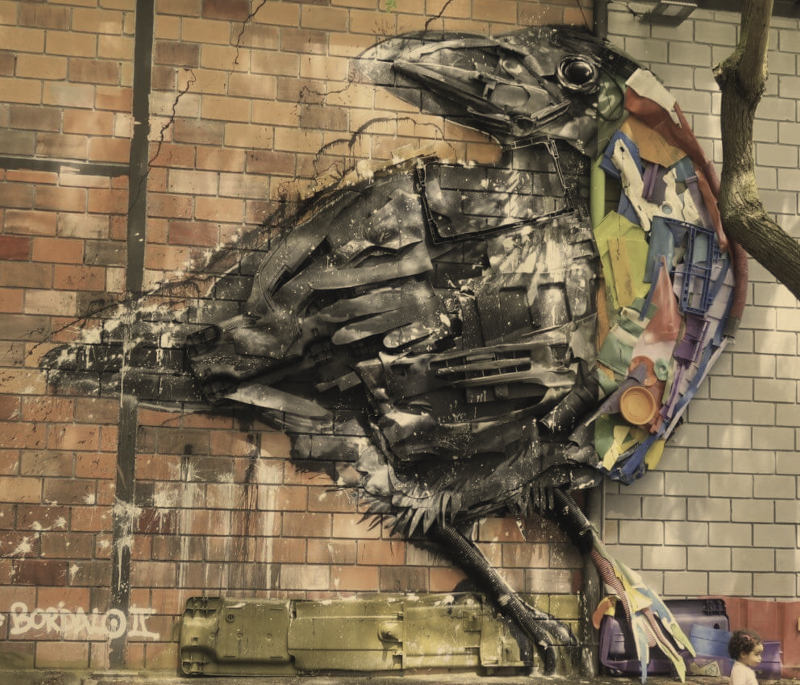
Reading it again now, it strikes me how I read it all at the time: Every find went straight to the table. "A Saturnian plant!" "A Saturnian animal!" On the Jupiter trip the year before, I saw storks and found a board game, and reached for my phone:
A quick online search [...] confirmed what I had already anticipated: storks are associated with Jupiter. Chess too.11
A find counted once the table said yes. The game I had found wasn't even chess, it was Go.
Yet I still do it like that: find, feel, check. What changed is what I think I'm checking against. Back then I treated the table as law, a record of where a planet's virtue lands, and checking meant asking whether a find was legit. Today I think of it as a memory, of everyone who found a crow before me and tied it to Saturn. Checking means asking whether anyone has been here before.
Agrippa's tables list the crow for Saturn4, and some modern ones the morning glory5. But the table could only confirm my finds, it couldn't have predicted a single one. It has a cell for crow, none for a crow made of trash. It has a cell for wood, maybe pine, none for that scorched pine, or the one branch that came down shaped like his sickle. What found me wasn't the category, it was this crow, this hedge, this branch. Isabelle Stengers, on an Omaha prayer to a boulder:
[it is] not a boulder, a 'block of stone,' the Omaha addresses, but this boulder, in this place where it rests, of which it is an integral part20.
And every time someone writes down a find like that, the memory grows. So the question changes. Not "is this Saturnian?" but "what tied it to Saturn, and did the tie hold?"
The God in the Cat
If these finds are correspondences, what are they correspondences of? The best answer I know is a Kemetic one.
The old Egyptian word we translate as "god" is nṯr (netjer), plural nṯrw (netjeru), and the translation loses most of it. A netjer wasn't a person living somewhere above the world, and it wasn't a principle behind it either. A netjer was at home in things. Erik Hornung, writing about the sacred animals:
Individual animals are not the god, but the god may take up his abode in them; they allude to him and are images and vessels of him21.
Vessels. Like a scrying sphere. And vessels can be made. The temple statues, which the gods "enter", were made of the most precious materials "in order to resemble the true body of the god as closely as possible", and a priest served them every day6. The god lives in what people make and keep.
Take Bastet. Herodotus, travelling Egypt in the fifth century BC, found her in her city, Bubastis, at the festival Egyptians kept "with the greatest zeal and devotion". They came by boat, crowds in every boat, with rattles and flutes, and "more wine of grapes is consumed upon that festival than during the whole of the rest of the year". And when a cat died anywhere in Egypt, it was carried to Bubastis, embalmed and buried there7. The cat, the city, the rattle, the wine: none of them is Bastet, all of them are where she lives.
Herodotus, being Greek, filed her under Artemis. That's what a table does. The Egyptian priest in the daily cult had to say the opposite, in front of the god's image: "I have not equated your nature with that of another god"8.
Hornung's best line on the netjeru is that they are "formulas rather than forms", never finished, always "under construction" like their temples9. Not an essence that cats and wine copy, but a combination that keeps taking things in. That combination is what I call a god's series.
That doesn't mean the Egyptians kept their gods apart. They combined them all the time, and Amun-Re is only the best known. But Hornung, following Hans Bonnet, insists that a combination like that is not an equation. The Amun-Re formula
observes that Re is in Amun in such a way that he is not lost in Amun, but remains himself just as much as Amun does, so that both gods can again be manifest separately or in other combinations22.
Bonnet's word for this kind of syncretism is inhabiting, the same move as a god taking up his abode in a cat. Herodotus' table put Artemis in Bastet's place. Amun-Re keeps both.
That's how I'd read Saturn on Tenerife. The Romans had filed the Carthaginian Baal-Hammon under Saturn, and that equation is how I found him on the island10. But what I met there wasn't a table entry. Saturn was at home in Baal-Hammon, "physically present on every inch of the Canarian isle", as I put it in Call of the Siren, and neither was lost in the other. His consort Tanit was at home in the same way in the Virgin of Candelaria, the island's patron. The burnt pine, the hedge and the crow weren't messages from a planet up there. They were Saturn's formula as it happens to be written on Tenerife.
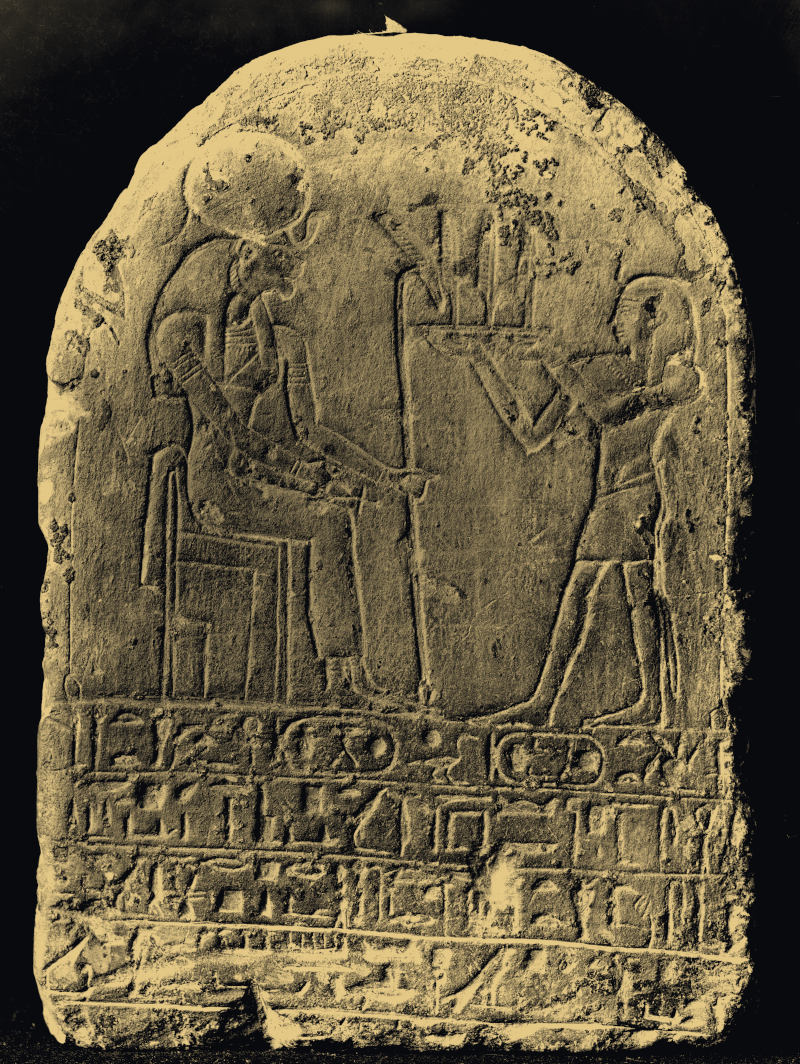
At Bubastis, Bastet wasn't only in the cats and the wine. She was in the crowds in the boats too, in their rattles and their drinking. A vibe can be a vessel. That's also why a place can put you in one. A grey city can make you Saturnian. After the Jupiter rite I wrote that my mind and the world are "not two separate worlds, but rather different points of one spectrum"11, and I'd still sign that.
A friend asked me the obvious next question. If metals and plants have their planets, does the psyche have them too? Is astrology an outer map of an inner system? Modern astrology mostly says yes and moves the planets into the head: Saturn becomes a complex, a part of you. I would say the answer is: neither. There aren't two systems, one inside and one out. There's one formula or series, and a mind is one more thing it takes in, the way Bastet took in the cats and the city. Saturn in a mind isn't a picture of Saturn out there. It's Saturn there, the same character taken up as slowness, weight and a pull towards solitude, the way a pine or a crow takes it up.
Where planet and 'psyche' fit neatly, part of the reason they fit is copying. Saturn wasn't always the planet of melancholy. Astrologers and physicians tied them together over centuries, and Ficino turned the tie into the planet of scholars12. For him you didn't need to be born under Saturn to come under him. You could get there by what you did:
by withdrawal from earthly things, by leisure, solitude, constancy, esoteric theology and philosophy, by superstition, magic, agriculture, and grief, we come under the influence of Saturn23.
People learned to feel Saturnian from the tables, and the tables learned from them. Ficino built Saturn a new vessel, the scholar at his desk, and Saturn moved in.
Tying it Together
So how does a thing join a planet? Ramsey Dukes has a theory of how the tables got made. Magic starts with a feeling for "what goes with what":
when rationalism takes over there is an urge to systematise and try to 'pin down' this feeling, [until] we inherit the highly complex tables of cabalistic correspondence24.
Pinned down, every entry looks the same: a word in a spreadsheet cell. But they didn't get there the same way, and they don't hold the same way either. I can see several ways in.
The strongest one is shared constraint: the Moon pulls the sea. Nobody had to agree on that. Ptolemy gave the Moon her moisture for physical reasons too: she is close to the earth and its moist exhalations13. The Moon and water are held together by the world itself. A tie like that needs no tradition. Burn every table and someone would find it again.
Another strong tie is contact: for Jupiter I put an olive branch on the altar that I had taken from a small tree next to the altar of Bona Dea in Croatia1. The Moon got the incienso that grows around the cave house, Mars the dragon's blood I harvested on Tenerife myself, the Sun a table of practice I built with my own hands. A contact is felt intuitively and it holds where it was made.
A similar but weaker tie is likeness: the sickle branch. Or the room in La Orotava where I did Venus under the tapestry over the bed: the Star card, a naked woman rising from water towards a radiant star, with the sign of Venus among the symbols, "the most venusian version of the Star card I had ever come across"14. The qualities it runs on are real. The crook of the branch and the water in the picture aren't something my mind adds to things15. Why are they weak? Because on its own a likeness is just one coincidence. Plenty of branches are crooked. Likenesses become contact when they accumulate to synchronicities.
Ties don't just happen, they can also be made intentionally, for example through offering: Edward Butler on the Eye of Horus:
Whatever is the substance offered, once it has been made a divine offering it becomes the Eye of Horus25.
Giving is a way in of its own. Isis' knot was carved from red stone for her blood and then charged with the words "Thou hast thy blood, Isis"16. A likeness, sealed by an offering. And the Moon's tap water became hers by being poured into the ground.
The most common tie is obviously copying: RO's list. The Glenmorangie was a fine Jupiter, and the list got me started. A copied entry means something because of the other entries around it, the way a word means through the rest of the language17. That's why a table holds even when nothing outside feeds it anymore, and why it can go stale: a closed loop. Herodotus filing Bastet under Artemis was copying too. Donna Haraway's line, via Stengers, is the right warning: "It matters which ideas we think other ideas with"18.
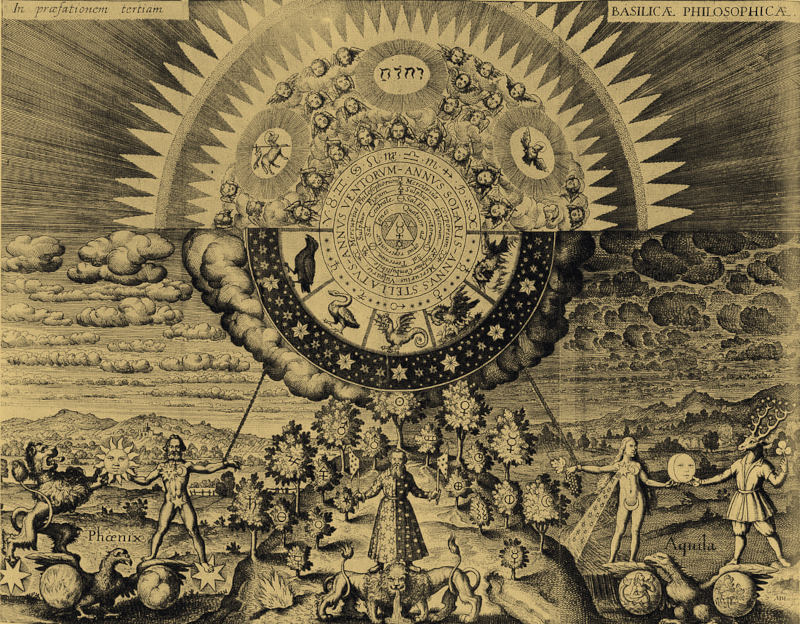
Back to the jigsaw puzzle from Dropping Crystal Balls: a piece is held by its neighbours19. The more ways a thing is tied in, the better it holds. The Moon's tap water was tied three ways: by the Moon's pull on water, by the source in the rock it came from, and by the pouring. None of them are on RO's list. The sickle branch is tied twice, by its shape and by the place it came from. And a thing can be tied to more than one planet. The galerías gave the Moon her water and Saturn his dark hollow in the rock, but not by the same tie: the water is the Moon's by constraint, the hollow is Saturn's by likeness and by the rite I did in one. Saying which tie does the work prevents "several" from meaning "anything".
Cup and Dagger
A table of your own grows one find at a time. Here's how I'd go about each one:
-
Cup first, Dagger later. In How to See Fairies, a six-week course in psychic perception, Ramsey Dukes borrows two of the ceremonial magician's "magical weapons" as names for two states of mind26. The Cup is the open one. It takes in impressions, through the senses or as hunches, and holds them "in their wholeness without division or analysis", because "its job is to receive and hold, not to classify or analyse". The Dagger is the sharp one: it looks at an impression, names it and sorts it. Neither is better, Dukes insists, "these two states of mind are equally valuable", but our schooling treats the Dagger as the grown-up and the Cup as child's play. So he asks you to lay the Dagger aside until results come in, and only then "bring back the Dagger to separate the wheat from the chaff". The find and the feeling are the Cup, and the table is the Dagger. Find first, check later.
-
Start with what's in the house. Treat RO's list as a menu, not a shopping list. For Jupiter I put dried laurel leaves "from the kitchen" on the altar1, and the Moon got the tap water. Whatever is already in the house has been chosen once, and it's already tied to you. Start there, and go shopping only if nothing in the house answers.
-
Say what you need, then stop looking. On Tenerife the morning glory turned up the moment I'd finished thinking that I needed "materials, incenses, candles, corresponding plants..."10. I didn't find it by searching. I found it by deciding on the rite, naming what it needed, and then going about my day with the Cup open. All the Tenerife finds came like that, in the days before the rite, and none of them in a shop. There's a name for this: the frequency illusion. Name a thing and suddenly it's everywhere. I don't think that's a flaw in the method, it is the method: the Cup decides what you get to see. What it can't decide is what holds.
-
Ask what it ought to taste like. When Dukes tried to see the aura of his favourite hawthorn, but couldn't, he asked what it ought to look like, and the answer came at once27. For me this method does not work. What does though is delegating the Cup to an imaginary helper. In my case I envision a small elf-like creature with a pointy wizard hat, floating in front of me, that asks naively what the thing ought to be like. Since I just observe it without judgement, the answer usually comes instantly. Have it ask the same of a drink, a resin, a stone that fits a planet. I know it sounds ridiculous. Try it!
-
Let the table say no. When the Dagger comes back, give it something to cut. Write the find down before you look it up, so the table can't tell you what you saw. Look for a second tie, the way the sickle branch has its place as well as its shape. And ask whether the find would have done just as well for another planet. If it would, it's tied by your looking, not by the thing. Keep what holds: that's your table.
My Jupiter week would have failed that test. The day after the rite I walked through Ludwigshafen, and everything there felt Saturnian: the chimneys, a fallen Prometheus outside a school, even a branch of the Saturn electronics chain. I filed it all under Jupiter, by way of Zeus' Titan ancestry. At the time I even wondered "if all of this was already meant for me to think about or if I am just a mythology nerd"11. Today I'd say: mythology nerd. If Saturn counts for Jupiter because Zeus overthrew him, anything counts. The grey was real, and it was Saturn's. Filing it under Jupiter was mine. But I forgive myself. It was the first ever initiation, my Cup was wide open and I'd forgotten to bring the Dagger.
Abandoned
The sickle branch lies in a basement in Berlin, with everything I couldn't take to Israel. That's most of my materia magica, because how do you explain a box of resins, seals, feathers, blades and a burnt branch to the strictest airport security in the world?
That box is my personal correspondence table. Every object in it was tied to a planet once. But stored like that, with no rites since, it has become a closed loop.
The house we live in now also felt like a closed loop, and very Saturnine. It belonged to my wife's grandparents, artists who kept everything. It feels cursed. The house slows everything down. Any attempt of proper renovation. But instead of fighting it I added to the series: I planted morning glory to grow over the dead tree in the yard. It flourishes like nothing else around the house.
-
Rufus Opus, Seven Spheres, "Closeout", p. 120. ↩
-
The crow in Henry Cornelius Agrippa, Three Books of Occult Philosophy (1533), I.25, "What things are Saturnine". ↩
-
Scott Cunningham, Cunningham's Encyclopedia of Magical Herbs (Llewellyn, 1985). ↩
-
Hornung, p. 135. ↩
-
Herodotus, Histories II.59–60 and II.66–67, trans. G. C. Macaulay (1890). ↩
-
Hornung, p. 186. Edward P. Butler builds his polytheism on passages like this one: positing a god behind the gods "comes from superimposing a logic of concepts over a logic of individuals", while the gods, "in becoming real, become the world". The Metaphysics of Polytheism in Proclus (dissertation, New School University, 2003), pp. 55–57. ↩
-
Hornung, p. 256. ↩
-
Raymond Klibansky, Erwin Panofsky and Fritz Saxl, Saturn and Melancholy: Studies in the History of Natural Philosophy, Religion and Art (1964; McGill-Queen's University Press, 2019). The tie was "definitely established for the first time by certain Arab writers of the ninth century", Abū Maʿshar among them (p. 127); in the late Roman Empire "no lasting connexion was established between Saturn and melancholy as an illness, let alone between Saturn and melancholy as a temperament" (p. 148). On Ficino, pp. 255–61: "all 'studiosi' are predestined to melancholy and subject to Saturn; if not by their horoscope, then by their activity". ↩
-
Ptolemy, Tetrabiblos I.4, trans. F. E. Robbins (Loeb, 1940). ↩
-
Alfred North Whitehead refused "any theory of psychic additions to the object known in perception": "what is given in perception is the green grass", not greenness added by the mind to molecules and radiant energy. The Concept of Nature (Cambridge, 1920), ch. II, pp. 29–30. ↩
-
Book of the Dead, spell 156, quoted in Butler, "Isis", Henadology. ↩
-
Kohn's symbol, which refers "by virtue of the established system of relationships it has with other words". How Forests Think, ch. 1. ↩
-
Stengers, Making Sense in Common, ch. 7, p. 164. ↩
-
Whitehead calls this immanent law: "the characters of the relevant things in nature are the outcome of their interconnections, and their interconnections are the outcome of their characters". Adventures of Ideas (1933), ch. VII, pp. 111–13. ↩
-
Isabelle Stengers, Making Sense in Common: A Reading of Whitehead in Times of Collapse, trans. Thomas Lamarre (University of Minnesota Press, 2023), ch. 7, p. 164. ↩
-
Erik Hornung, Conceptions of God in Ancient Egypt: The One and the Many, trans. John Baines (Cornell, 1982), p. 137. ↩
-
Hans Bonnet, Reallexikon der ägyptischen Religionsgeschichte (1952), p. 239, quoted in Hornung, p. 91. ↩
-
Marsilio Ficino, De vita libri tres (1489), III.2, in the translation of Klibansky, Panofsky and Saxl, p. 261. ↩
-
Ramsey Dukes, SSOTBME Revised: An Essay on Magic (The Mouse That Spins, 2002), ch. 2A. ↩
-
Ramsey Dukes, How to See Fairies: Discover Your Psychic Powers in Six Weeks (Aeon, 2011), p. 32 and Week 4, pp. 116–17. ↩
-
Dukes, How to See Fairies, Week 5, pp. 136–37. ↩
Comments