The planets are sublunar too. What happens when we draw the heavens down to earth.
In April 2019 I sat down in my room in Berlin in front of a wooden table of practice painted with divine names, a glass scrying sphere from a New Age shop in its centre, and called on Sachiel. I felt absolutely ridiculous. It was the first of seven planetary initiations. A few days later I climbed the Heiligenberg above my hometown Heidelberg, stood in the ruins of the Roman temple on its summit and recited the Orphic hymns to Zeus and to Hermes, the old lord of that hill1.
Three years later I finished the cycle with Mercury, at the same temple, on the same mountain2. In between lay Saturn in a water-mine cave on Tenerife, the Sun on a self-built Psithemius table, Mars on a new moon during the pandemic, the Moon in a cave house in the basalt of the island's south, and Venus in a rented room in La Orotava under a tapestry of the tarot's Star card.
It never felt like climbing, because I did the seven spheres in random order. Somehow that felt more natural for me from the start. Looking back, it was a circle. Or rather a spiral: I returned to the same mountain as a different person.
This article is about that what the planets are when you ditch the old ladder metaphor.
Cosmotechnics
This blog was called Sublunar Space long before I touched a table of practice. I chose the name out of a blurry sense that magic belongs down here, in the material world below the Moon where things are born, change and die. Of course I had no framework, just a vibe. So I did what you do when you don't have one: I wanted to learn from traditions that did. After a brief segway into the cringe that is sold as Kundalini Yoga I settled with what resonated most at the time: I prayed the planetary prayers, kept a half-assed routine of theurgy, dabbled a bit in Theoria, and then followed Trithemius through the seven spheres.
The western magical tradition comes with a picture of the world, and that picture is a tree with a ladder on it. The seven planets stand in the old Chaldean order, from Saturn at the top down to the Moon, each in its own sphere, and the soul climbs through them. The Hermetic Poimandres tells it most beautifully. After death the soul "doth speed his way thereafter upwards through the Harmony", giving back to each zone what it once received from it: to the first "the Energy of Growth and Waning", and so on up to the seventh, "Ensnaring Falsehood, de-energized", until, stripped of everything the planets had lent it, it reaches "the Eighth" and is "made one with God"3. The seven rulers who "enclose the cosmos that the sense perceives" are what men call Fate.
This story begins with a way down. Before any soul climbs, the primal Man "bent his face downwards through the Harmony", Nature "smiled with love", and "they were intermingled, for they were lovers"3. The ladder was built to undo a descent that came first, out of divine love.
My essay on the Moon initiation read her as the lowest of the spheres, a transmitter passing images down from above, although it never really felt that way, to be honest. What follows is the name of this blog catching up with itself.
What bothers me about how most of us practise planetary magic today, myself included, is that modern occultism keeps a centuries old map of the spheres and a geocentric cosmology, in some cases quietly swapped its spheres with inner planes, astral levels, states of consciousness, "a symbolic system".
A symbolic system can't be refuted. But it can't explain jack shit either, and the practice still talks as if the spheres were there. In Call of the Siren I dared to call ceremonial magic "pretentious cosplay". We are LARPing a cosmology that was overturned four hundred years ago and pretending that this is just "how magic works".
I'm not mocking anyone. I did exactly this for years and got a great deal out of it. And to be fair to the cosplay: it is half the work. Ritual, in my experience, works mostly through form: exact words, a fixed direction, a set hour, a marked space, repetition. A neoplatonic rite is a very precise form, and a precise form shuts most of the world out so that one particular thing can happen inside it. So I'm not saying anyone has to change what they love doing. I'm just saying: own it. Know that you're performing a form, not visiting a place. I know many of you already are, but there's also a worrying amount of people who double down on delulu.
The thing is that the actual tradition was building magic on what you actually believe the world to be. The people who drew the spheres weren't pretending. For Aristotle the heavens were made of a fifth element, the aether, "unaging and unalterable and unmodified"4. Ptolemy built them as real nested shells, each planet's machinery inside its own5. And Agrippa, whose Three Books of Occult Philosophy stand behind half of what we call Western magic, opens with exactly this picture: "every inferior is governed by its superior, and receiveth the influence of the vertues thereof", so the magician can hope "to ascend by the same degrees through each World" and "to draw new vertues from above". Notice where he goes to find those virtues: to "Physick, and Naturall Philosophy", to "the doctrines of Mathematicians"6. Medicine, physics, mathematics. Agrippa built his magic on the best science of his day. All of them did.
Even astrology was physics. "It is Saturn's quality chiefly to cool and, moderately, to dry", Ptolemy writes, "probably because he is furthest removed both from the sun's heat and the moist exhalations about the earth"7. Distances, exhalations, heat. Saturn doesn't literally make things cold. Plotinus, of all people, already said so. The stars, he wrote, are like "letters, at every moment flung along the heavens"; they "serve as letters for those skilled in deciphering this kind of writing"8. They signify. They don't cause.
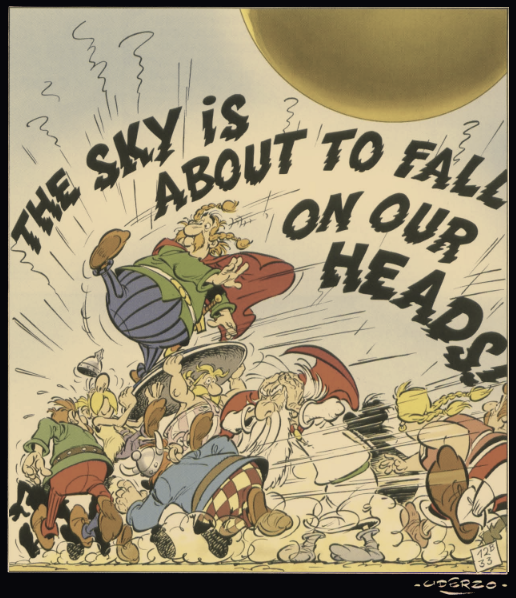
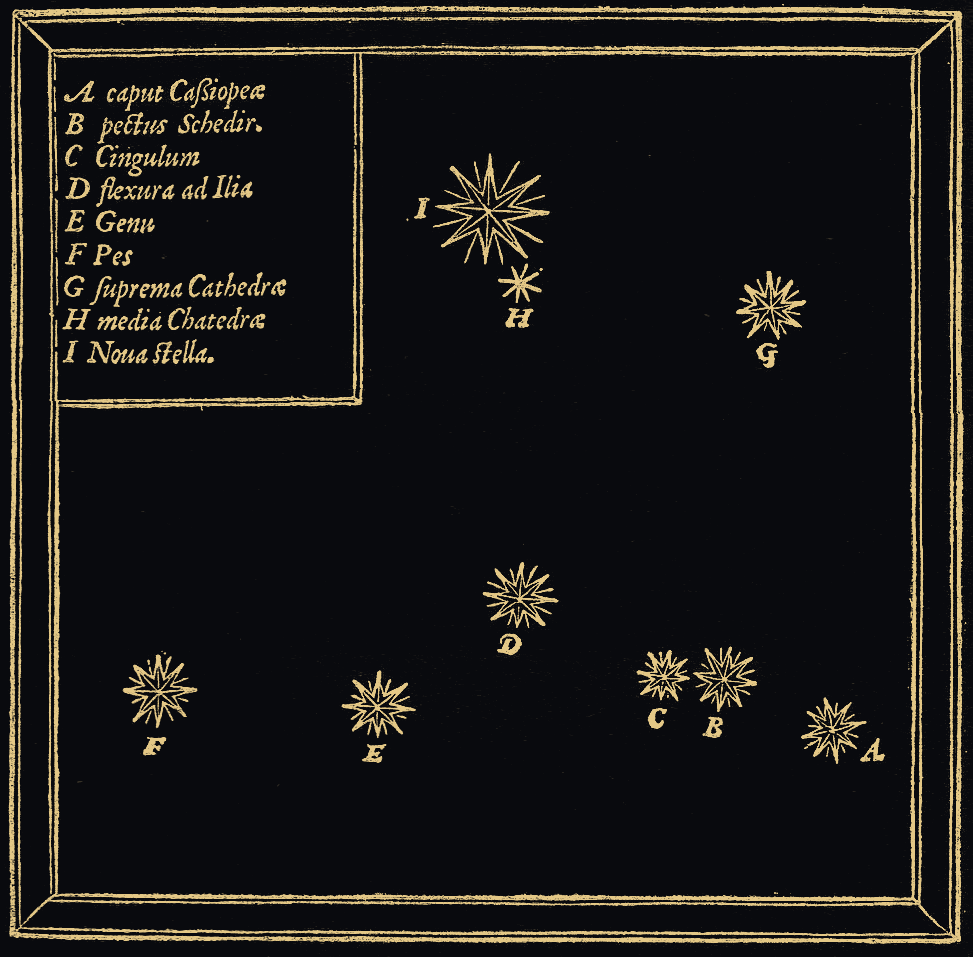
And then it all collapsed in public. In November 1572 Tycho Brahe saw a brilliant new star in Cassiopeia, far beyond the Moon, a supernova in the very heavens that couldn't change. Five years later his comet passed through the regions where the planetary spheres should have stopped it9. In 1610 Galileo pointed his telescope at the Moon and found it "just like the surface of the Earth itself, which is varied everywhere by lofty mountains and deep valleys", and four moons circling Jupiter10. After Kepler and Newton the heavens were made of the same stuff as the Earth and moved by the same laws. The crystal balls had been dropped.
The cybernetic philosopher Yuk Hui has a term for what the old magicians were doing: cosmotechnics, a way of binding the moral order to the cosmic one through technique. And he is crystal clear about the task: "being at odds with modern science is not an excuse not to develop a cosmotechnical thinking that will organologically inscribe science in its working principle"11. In plain words: if you want to be faithful to the old magicians, do what they did. Build on the best picture of the world you have!
A Sublunar Ontology
That doesn't mean swapping the grimoire for the schoolbook. The scientific mainstream model is insufficient too, in the opposite direction. Science isn't the problem. The method is the best tool we have. The problem is the metaphysics bolted onto it: that only dead matter is real, and whatever doesn't fit isn't looked at, because it isn't allowed to exist.
Mathematician and philosopher Alfred North Whitehead diagnosed this a century ago. He called it scientific materialism: a cosmology that presupposes "an irreducible brute matter", "senseless, valueless, purposeless". He was fair about it. "It is not wrong, if properly construed", and within its abstraction it "expresses these facts to perfection". The mistake is to take the abstraction for the world, "mistaking the abstract for the concrete", which he called the "Fallacy of Misplaced Concreteness"12. The spheres took a model for the heavens. Scientism takes an abstraction for the world. Both mistake the map for the territory, from opposite ends.
I experienced a few weird things in my own life that aren't allowed to exist in that picture and I have written about quite a few on this blog. That's how I started searching for alternative epistemologies and after countless rabbit holes eventually found Whitehead. His Process Philosophy is compelling and refreshingly different, and it's stuck with me ever since I first grokked it during the plague years. Of course it has its quirks and a few cringeworthy moments, too, but those turned out to be fixable.
Over the last few years, I've been using it as a framework for gluing a picture of the world together, that holds up well. For me. For now, I'm calling it a sublunar ontology, fittingly for this blog, and for lack of a better name. But it kind of suits the 'nothing above the realm of change' vibe. Instead of throwing it at you all at once, I plan to weave it into this blog's content, gradually introducing this ontology as a lens through which I frame both my research and practice. Here's my very brief elevator pitch:
Nice new blue box, right? I made that up just for the ontoloy stuff.
Odd Kind of Sympathy
But back to the crystal balls. When the spheres shattered, the arrow survived. You can see it happen in my own notes on the seven vowels from 2017, Shudderful Names, which stack the next few centuries into a single quote collection: Nicomachus deriving the vowels from "the tones of the seven spheres", Manly P. Hall's seven heavens singing a harmony that "ascends as an everlasting praise to the throne of the Creator", a French occultist's "astral waves of the seven planets", and a modern handbook explaining that "Sound is a form of energy".
The story is always the same one: something higher and invisible transmits and something lower and material receives, just the carrier changes:
- Emanation. The spheres themselves, pouring virtue down the chain.
- Rays. Al-Kindi had already taught in the ninth century that everything emits rays that act on everything else25, and Agrippa's magicians sought "the Celestiall world in the Rayes, and influences thereof"6. When the spheres were gone, the rays did the work alone.
- Energies and vibrations. The Theosophists' Seven Rays, and today's "Saturn energy".
- Archetypes. Jung moved the planets into the psyche, but the patterns are still stamped from above onto the individual.
- Quantum something something. The newest carrier: "quantum energy", entanglement as the reason astrology works.26.
The tradition was diversified, though. In Daimonic Reality Patrick Harpur points out that the old philosophers described sympathy with two metaphors. One was "drawn from the model of the sun": the physical emanates from the spiritual "as heat and light radiate from the sun". The other was "drawn from music": things answer each other "as the strings of a musical instrument resonate in harmony with another set of strings". The first metaphor "lies behind all the fantasies of mysterious 'energies,' 'cosmic rays'"13.
The thing is: not everything up there is metaphor. Gravity is real. The Moon raises the tides twice a day, and that's a relation between two bodies, not a ray from a higher realm. A planet's pull on you is negligibly tiny, but real too.
In 1665 Christiaan Huygens, the inventor of the pendulum clock, noticed that two of his clocks hanging from the same beam kept falling into step. Whatever he did, after a while their pendulums swung together. He called it "an odd kind of sympathy"14. Nothing was sent from one clock to the other. They shared a beam, and through the beam each took the other in. That's the model I mean. Whatever shares a beam with the sky can fall into step with it. The shared beam is the society.
The anthropologist and cybernetician Gregory Bateson provides the logic. Ordinary causal explanation is positive: ball A hit ball B. "In contrast to this, cybernetic explanation is always negative": why all the other things that could have happened didn't. Its "restraints", he writes, "can in all cases be regarded as factors which determine inequality of probability"15. Nothing has to be pushed. Something only has to be ruled out, for one thing to become more likely than the rest. That's also a fairly better definition of divination: nothing pushes the result, the rite around it only rules things out.
What Are the Planets, Then?
If there is nothing above the Moon, metaphysically the planets are sublunar too. They have weather. Jupiter's storms are bigger than planet Earth. Saturn's rings are raining down into the planet and will be gone in less than a hundred million years16. Planets are wholes like everything else, held together by their own members, only enormous and slow.
And you never see them as they are. The Moon's light is a little over a second old when it reaches you, the Sun's eight minutes, Jupiter's half an hour to almost an hour, Saturn's well over an hour. Every time you look up you take in the past. What reaches us from the planets is what they were, and every moment down here is free to take it up.
What reaches us that's measurable is light, gravity, and rhythm. The Moon's month, Venus drawing her pentagram over eight years, Saturn coming back to the same place every twenty-nine and a half years. Those cycles are the beat and everything on Earth that keeps time with them, calendars and harvests and festivals and the hour of Saturn, falls into step through what it shares.
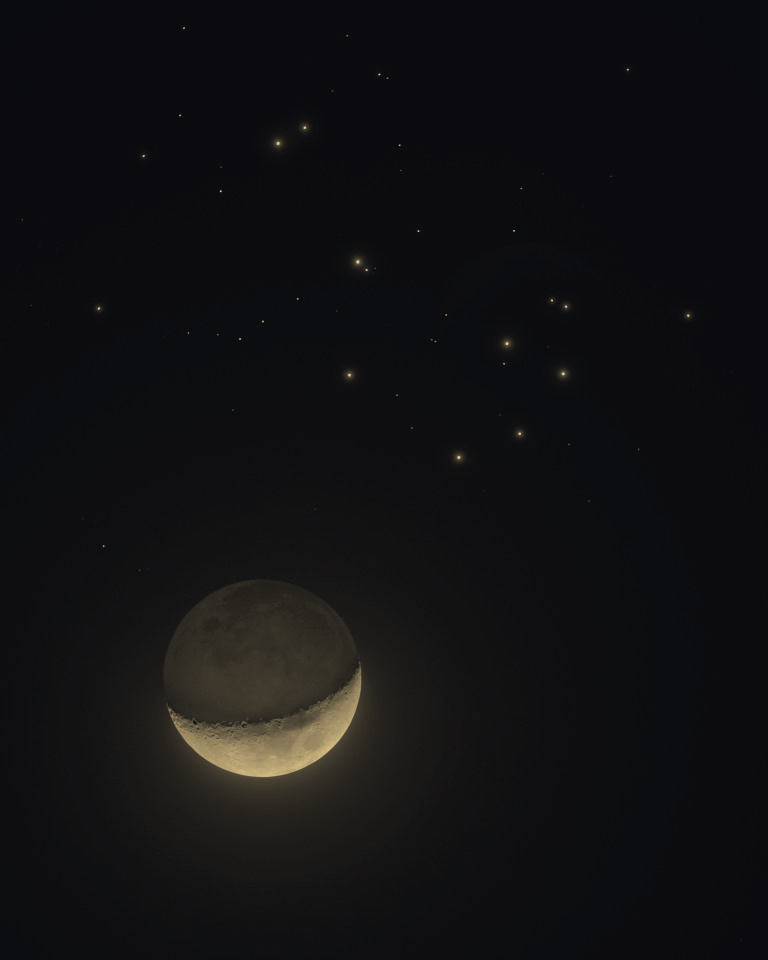
So if there are no rays and no influence from above, how the heck does astrology work? Timing and correlation, I think, and that's actually more than it sounds. An election is joining a rhythm that many people have kept before you. Whether a chart can really predict the future is still open, a thousand plus change years later. The tests so far are weak and contested17. But as an art it can be damn uncanny. My friend Ricardo, a fellow researcher and a good astrologer, once read my personality, my problems and my gifts from nothing but my birth chart, and he was more spot on than any psychologist I've ever sat on the couch with. I think the skill of the astrologer is what Harpur calls double vision, avoiding the trap of literalism both ways: neither taking the planets for a heavenly host, nor seeing a light in the sky as "only a ball of hot gas or a barren planet." Both are "just as literal-minded". The remedy is metaphor, which "as its etymology suggests, is the ability to 'carry across'"13. A good chart reading carries across, from the sky to a life. The correlations are there to be read, and reading them is the artistic skill.
Planetary Loops
First, an obvious question I have asked myself since the moment I considered planetary magic at all: if I take science seriously, why only seven? Uranus and Neptune are as real as Saturn. I have always dismissed it on the grounds of "tradition" and that worked for me. Now I understand that being real isn't the point. Membership is.
The seven are the wanderers a human eye can see, nobody remembers where their names came from and for thousands of years everyone who looked up took them in and built weeks and hours and vowels on them and carried their series through calendars and harvests and ancient mysteries. Uranus has had its name since 1781, Neptune since 1846. Pluto only had a brief moment as a planet. Their series is two centuries thin, borrowed mostly from the old gods they were named after, and carried only by modern astrologers' keywords. We know the human individuals who named them. The young planets are young gods, if they are even gods yet. I still shut them out, because I just don't expect them to answer the way Saturn does, but that, too, can and should be tested.
Now look at the seven again. The same Chaldean order that makes the ladder (Saturn, Jupiter, Mars, Sun, Venus, Mercury, Moon) also makes the week. Give each hour of the day to the next planet in that order, round and round, and the first hour of each new day falls to the Sun, then the Moon, then Mars, Mercury, Jupiter, Venus, Saturn. Sunday, Monday, and on. The Roman historian Cassius Dio, who records this, also gives a second explanation: count the planets by skipping two each time, like the intervals of a tetrachord, and "you will find all the days to be in a kind of musical connection with the arrangement of the heavens"18. Draw that skipping as lines between seven points on a circle and you get the heptagram.
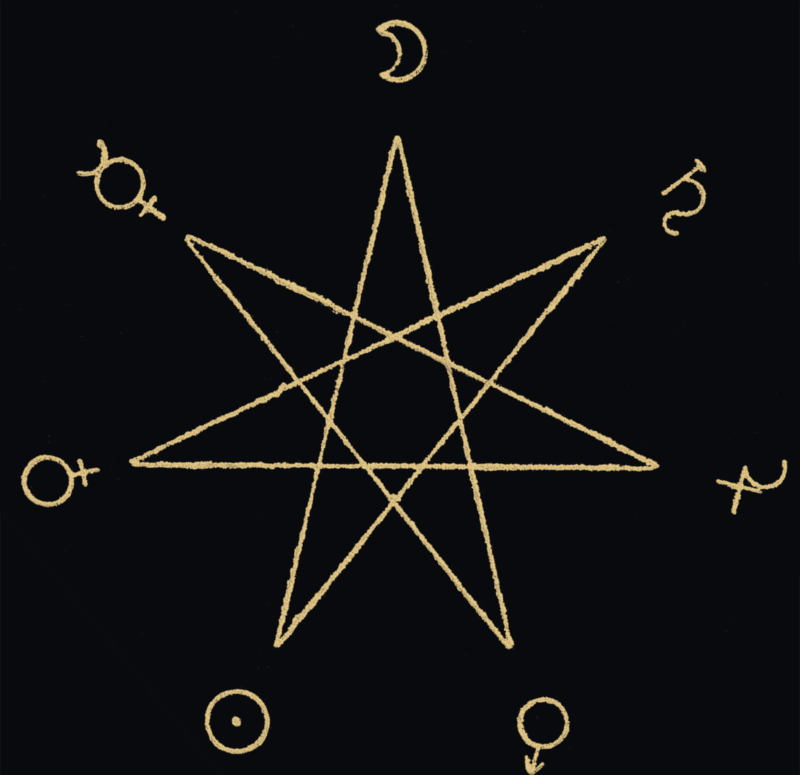
If we arrange them in a wheel instead, no planet sits on top. Each one presides for an hour or a day, then hands over to the next. The head is borrowed and each planet is the centre from where it stands. The mages even sang the wheel: the seven vowels are the planets as sound, and the papyri have you voice them in sequence, imitating the god's own voice: "Lord, I imitate you by [saying] the seven vowels; enter and hear me"19.
Egypt had an even much older wheel: the thirty-six decans, star gods rising one after another through the year, each presiding for about ten days. They gave me the strangest insight of the whole cycle. For months Ricardo and I had researched how the decans' star groups were matched to the ecliptic, and our working hypothesis was that the system was obviously sidereal. After my solar initiation a chain of synchronicities pointed clearly to looking at them with a tropical lens instead, which we did not expect. I took that as a meaningful pattern, not a proof for anything. But I like where it points: the tropical wheel is set by the Earth's own year, by equinoxes, solstices and seasons. A relation down here instead of the fixed stars "above".
I also don't believe the decans were star clocks, as the usual story goes, with coffin lids full of tables for telling the hours of the night. Joanne Conman has made the case against that reading20, and when I look at the tables myself, with their occasional repetitions of "triangle decans" along the edges, they look less like precise time slots and more like priests keeping track of which stars had shown up that were expected to show up, in the right order. Their concern wasn't what time it was. It was that the world would continue for another day. Iamblichus, as Jan Assmann quotes him: "Everything remains stable and ever new, because the course of the sun has never been halted." For the Egyptians, "Good is that which keeps the world stable and ongoing"21. They were priests, not scientists. Egyptology has a tendency to confuse the two.
The stars didn't need the priests to keep turning. But the ordered world the priests lived in did. Their timekeeping was their part in keeping the wheel going, members tending an order that is held together from below.
The ladder is a chain of command. The wheel is a loop. Yuk Hui describes recursion as "the looping movement of returning to itself in order to determine itself, while every movement is open to contingency", a spiral whose every turn is shaped "partially from the past circular movements"11. The week is like that. It comes back, and each return carries what the earlier ones left.
My seven initiations "worked" although I didn't climb the Chaldean ladder as instructed. It was a wheel, each planet taking the chair in my life for a while and pointing me to the next one. Jupiter brought sovereignty, and an old knot with my parents. Saturn brought time, and an overdue urge to grow a sense for stability. The Sun brought the decans. Mars taught me to follow my instincts and overcome my distrust in authority. The Moon turned the mirror inward. Venus moved my family to Carmel. Mercury brought me home, to the hill where it had started.
Correspondences
That leaves the long lists of metals, plants, animals, colours, days and illnesses that belong to each planet. In Agrippa's picture they are channels. A virtue flows down from Saturn through his sphere into lead, the pine and the goat, and the magician can tap it.
Read from below, lead and the pine are members. A planet's character on Earth is carried across many domains, metal and tree and animal and day and hour and place and temperament, and the table is a record of what that series has taken up over the centuries. Being carried across so many domains is what makes Saturn a god, rather than a local spirit.
Bateson has the perfect image for how such membership works. Why does a jigsaw piece go where it goes? Because its shape "must conform to that of its several neighbors", its colour to its region. For the person solving the puzzle these are clues. "From the point of view of the cybernetic observer, they are restraints"15. Lead belongs to Saturn the way a piece belongs in its gap: held there by its neighbours, not by anything emanating into it.
The table has a memory. Every time someone burns storax in Saturn's hour or wears black on a Saturday, that use goes back into the series and makes the next use a little more likely. Used like that, a correspondence offers a series something it already includes. A membership is renewed. A table copied unchanged for centuries becomes a closed loop that only confirms itself, and at worst a franchise, something magical lodges and orders are really good at.
An open loop takes in what turns up. On Tenerife, Saturn found me as a burnt pine, a herd of corkscrew-horned goats, a hedge of morning glory, a crow and Baal-Hammon22. On the Heiligenberg, the Mercury of the Roman temple was a local god the Romans called Mercurius Cimbrianus and some of the locals probably Wotan or Lugos1. Those are correspondences no lodge spreadsheet ever has a cell for. You can only find them in places.
There is a lot more to say about correspondences and materia magica read through a sublunar lens. That's probably going to be an article of its own.
This one goes out on a Moon-day, at the new moon, in the Moon's hour. New moons are the traditional time for beginnings, and this is one. Somewhere above me she stands, invisible, lost in the glare of Helios, in light that left his surface eight minutes ago and his core before any human knew about farming.23
-
Corpus Hermeticum I (Poemandres), §§9, 14, 25–26, trans. G. R. S. Mead, Thrice-Greatest Hermes, vol. 2 (1906). ↩↩
-
Aristotle, On the Heavens I.3, trans. J. L. Stocks. ↩
-
Ptolemy, Planetary Hypotheses; see Bernard R. Goldstein, "The Arabic Version of Ptolemy's Planetary Hypotheses", Transactions of the American Philosophical Society 57.4 (1967). ↩
-
Henry Cornelius Agrippa, Three Books of Occult Philosophy I.1 (London, 1651). ↩↩
-
Ptolemy, Tetrabiblos I.4, trans. F. E. Robbins (Loeb, 1940). ↩
-
Plotinus, Enneads II.3.7 and III.1.6, trans. Kenneth Sylvan Guthrie (1918). ↩
-
Robert Ball, Great Astronomers (1895), on the star of 1572. Museo Galileo, "Tycho Brahe". ↩
-
Galileo Galilei, Sidereus Nuncius (1610), trans. E. S. Carlos (1880). ↩
-
Yuk Hui, Recursivity and Contingency (Rowman & Littlefield, 2019). ↩↩
-
Alfred North Whitehead, Science and the Modern World (1925), chapters I and III. ↩
-
Letter to the Royal Society, 27 February 1665. The mechanism was worked out by M. Bennett, M. Schatz, H. Rockwood and K. Wiesenfeld, "Huygens's clocks", Proceedings of the Royal Society A 458 (2002). ↩
-
Gregory Bateson, "Cybernetic Explanation" (1967), in Steps to an Ecology of Mind (1972). ↩↩
-
James O'Donoghue et al., Icarus (December 2018); NASA Goddard press release, "NASA Research Reveals Saturn is Losing Its Rings at 'Worst-Case-Scenario' Rate". ↩
-
The best-known test, Shawn Carlson's "A double-blind test of astrology" (Nature 318, 1985), came out negative; Suitbert Ertel's reanalysis (2009) argues the design was unfair and finds marginal above-chance matching. Weak and contested, in other words, not a knockout either way. Harpur himself calls such events "uncaused"; I'd rather say they are correlated, and leave the mechanism open. ↩
-
Cassius Dio, Roman History 37.18–19, trans. E. Cary (Loeb). Dio also notes, just before, that the Jews keep "the day called the day of Saturn". ↩
-
PGM XIII. 646–734, in Hans Dieter Betz (ed.), The Greek Magical Papyri in Translation (1992). ↩
-
Joanne Conman, "It's About Time: Ancient Egyptian Cosmology", Studien zur Altägyptischen Kultur 31 (2003). Her reading is contested. ↩
-
Jan Assmann, Of God and Gods: Egypt, Israel, and the Rise of Monotheism (University of Wisconsin Press, 2008). ↩
-
R. Mitalas and K. R. Sills, "On the Photon Diffusion Time Scale for the Sun", The Astrophysical Journal 401 (1992), 759–760, put the light's way out of the core at about 170,000 years. Michael Stix, "On the Time Scale of Energy Transport in the Sun", Solar Physics 212 (2003), 3–6, makes it about 30 million years for the energy itself. Farming is around 12,000 years old. ↩
-
The skeleton is Whitehead's process philosophy (Process and Reality, 1929), in my own plainer words. The mechanics of feedback and novelty come from Yuk Hui and from Alicia Juarrero, Dynamics in Action (1999). ↩
-
Al-Kindi, De radiis (On the Stellar Rays), known only in Latin; critical edition by M.-T. d'Alverny and F. Hudry (1975). ↩
-
Patrick Harpur noticed the pattern decades ago: "Students of the daimonic — Spiritualists, ufologists and so on — excitedly invoke subatomic physics as evidence that other dimensions, other worlds are possible and real." (Daimonic Reality, 1994). ↩
Comments