Part four of a hazy and mazy philosophical dungeon crawl about progressive but haunted political theory and praxis and bottom-up process ontologies for the End Times that emerged out of conversations with The Others on Discord.
In the first part we mapped out the Gnostic Kenoma of Capitalist Realism and the Gnosis of Acid Communism. In the second part we pulled the red thread through digital acceleration and hypostitional collapse toward the pull of the Outside Attractor. In the third part we descended into the plague years and came back up with a direction. Now we stop mapping and start digging.
Rule from Beneath
Let me begin with a confession: it has been here the whole time. It sits in the tags of every part of this series since the first one went online in the summer of 2025. The last part ended on the words "From Underneath." I have been writing toward this word for over a year without once saying it out loud. So here it is, let me vibrate it like a formula: Hypogearchy.
Three Greek pieces. ὑπό, hypo, beneath. γῆ, ge, the earth. And ἀρχή, arche, which means rule, but also beginning and first principle1. Rule from beneath the earth. Or, read the other way round: the principle that begins underneath.
The word has two much older and much more famous siblings: Hierarchy is sacred rule, from ἱερός, hieros, holy: rule from above, the vertical order of priests, emperors, and the Archons2 we met in part one. Anarchy is well known: the absence of arche, no rule at all. Hypogearchy is a third option the Greek language allows and nobody seems to have bothered to claim: rule with a source that is below.
Remember the loaded gun from part one. Mark Fisher, unable to revive the tainted signifier communism and unwilling to define his project by what it opposed, wrote:
At the moment, our desire is nameless – but it is real. [...] At some point in this process, the name for our new desire will appear and we will recognize it.20
Of course I am not claiming to have found the name for Fisher. What was produced in the Others Discord in the spring of 2021, half as a joke, was #acid-chthomunism, an unpronunceable clunky word made even clunkier. It's been a placeholder since, waiting to be substituted, thrice tainted, because what I eventually meant to say it was not a political party, not a program, not even an -ism. It has always been more of a feeling, a vibe, and primarily a vector, a direction. The same one we carried back up from the plague years in part three: inward, downward, toward the ground, the soil, the dead. But more than that the name needed to describe an action. The arche was the last puzzle piece.
And since this is the part of the dungeon crawl where all the overthinking gets done before the actual digging starts, let me say plainly what the #acid-chthomunism Discord channel and this whole series has been trying to do from the beginning.
It takes Fisher's Acid Communism and breaks both of its words wide open. Acid, taken not just at its implied psychedelic value, but the chemical one: beyond the flash that opens the mind it is the agent that eats through whatever it touches. Communism, widened to include the more-than-human world that lives below the floor of every human commons and beyond our doors of perception. This essay supplies the theory underneath both. The next one will supply the praxis.
Solar Empire
Before we can dig we have to know what we are digging through. So let's go back to the top layer, where part two left us standing: an Artificial Intelligence promising to become the universal redeemer, accelerationism as official ideology, billionaires pointing rockets at Mars, and Nick Land's Outside pulling everything toward a machinic singularity, an "invasion from the future"3.
Look at the direction of each of these. Up. Out. Away. Every escape on offer in the new Middle Ages points at the sky. Not only Them. Even, as we will see, the ones that call themselves ours.
It's not a coincidence, it's a default. The most dangerous kind of rule, because nobody experiences it as ruling. Let's take the spade and find out how deep it goes.
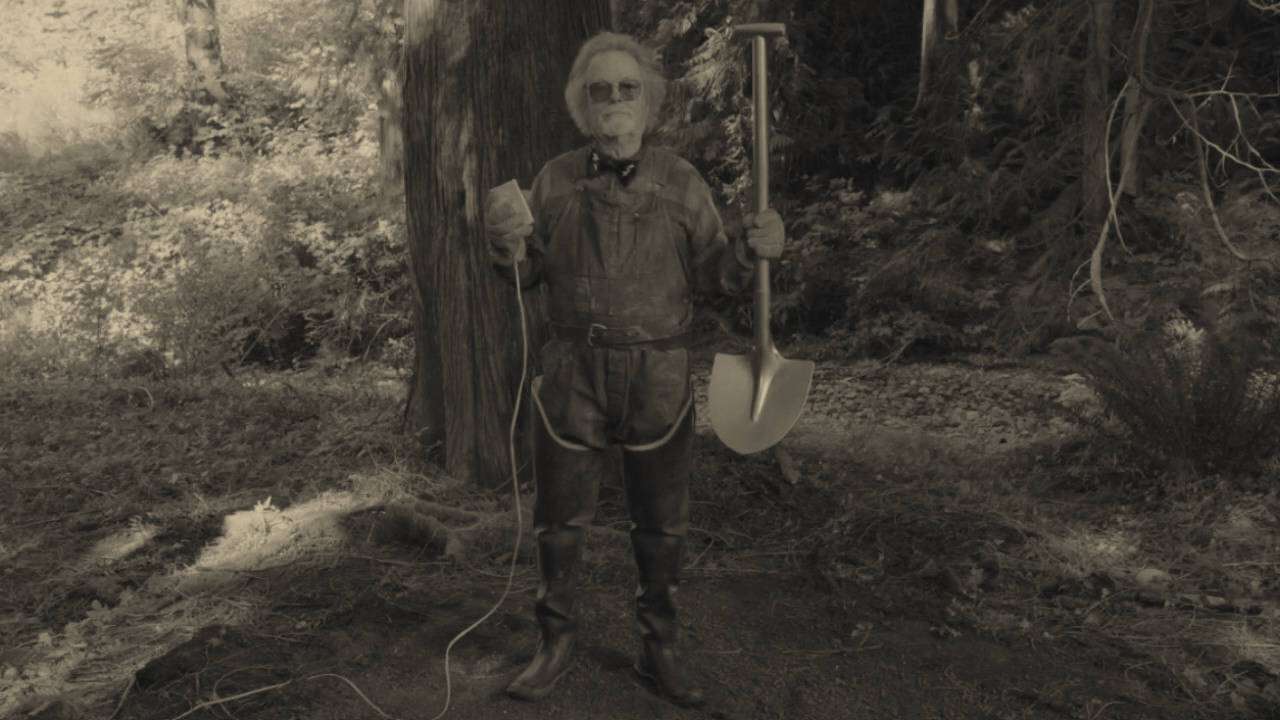
Shovel your way out of the shit and into the truth.
Just beneath the topsoil we hit solutionism: the conviction that every problem, the climate catastrophe included, has a technical fix waiting to be engineered by somebody with a sufficiently large budget and a sufficiently large view. Donna Haraway, the biologist turned feminist philosopher of science who will keep turning up the deeper we go, gave that view its name almost four decades ago: the "god trick of seeing everything from nowhere"4. She meant the posture of a science that pretends to have no body and no location.
It is the view from above, the divine sun, the one place in the old cosmos that sees everything and is too bright to look at. Solutionism is the god trick with a budget. Its hero is Prometheus, who stole fire from the gods, which is to say from the sun, and carried it down to us. Note that even the rebel moves along the same vertical axis. The testosterone-driven version of this hero worship, which the media theorist Alexander Galloway calls "Brometheanism"5, is the house religion of Silicon Valley.
Capital itself runs on solar logic. Georges Bataille, the dissident surrealist who devoted much of the 1940s developing an economics of waste, understood this clearly.:
The living organism, in a situation determined by the play of energy on the surface of the globe, ordinarily receives more energy than is necessary for maintaining life; the excess energy (wealth) can be used for the growth of a system (e.g., an organism); if the system can no longer grow, or if the excess cannot be completely absorbed in its growth, it must necessarily be lost without profit; it must be spent, willingly or not, gloriously or catastrophically.21
Wealth, in this picture, is collected sunlight that has to go somewhere. Growth is the only sanctioned way of spending it. And when growth stagnates, the surplus is burnt catastrophically: in wars, in crypto mines, in the compulsive destruction Jodi Dean diagnosed in part two. This is also, I think, why Capitalist Realism felt so metaphysical to Fisher and to all of us who read him. Capital did not invent its cosmology, it's the new form of the same old borrowed sun.
One layer further down lies the Enlightenment. The name says everything. Reason as a light that comes from above and dispels what lies below: the dark ages, the obscure, the superstitious, the underground. Ironically it was Copernicus who moved the sun to the centre of physics in the very same era in which cosmology, philosophy and politics tried to keep it firmly at the top.
Below that, Christian empire. Constantine's Sol Invictus, the unconquered sun, whose festival on the 25th of December became Christmas6. The halo, a little private sun around every sanctified head. The Sun King at Versailles, around whom the court and the state revolved by decree. Hierarchy, sacred rule, is not merely a metaphor for this arrangement. It is this arrangement, and the ladder only works in one direction: light descends, obedience ascends.
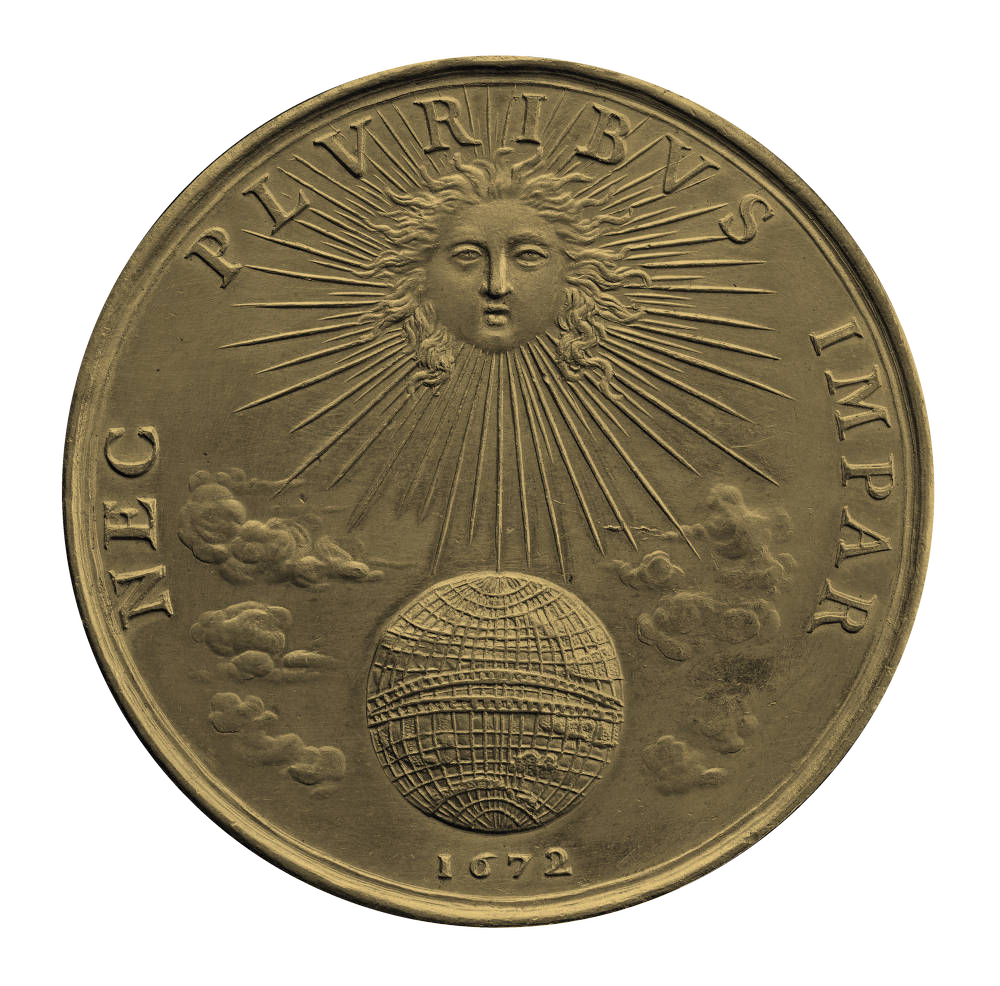
One more layer, and we are in PGM territory, among friends. Plotinus, in the third century, the father of what we now call Neoplatonism, systematised what had been floating around for six hundred years into the most elegant cosmology the West has ever produced and never since been able to shake off: the One at the top, overflowing, Nous and Soul spilling out of it, and at the very bottom, as the dimmest trickle of the light, crude matter7. Emanation. Everything that exists is a diluted ray of what sits above it.
And this is where I have to say we rather than they. The entire Western magical tradition inherited the ladder whole: "As above, so below" puts the above first. The correspondences descend from the planets to the metals, the herbs and the organs. The grades of every initiatory order ascend. I have attempted to climb that ladder myself, for years, and on this very blog: the routines in theurgy, the Helleno-Kemetic theoria, the planetary prayers, the Orphic hymns to Helios himself. We own this tradition.
The same goes for this series. The Gnostic frame of parts one and two, the Pleroma above the Kenoma, was an ascent story. And Fisher's desire, the one "that comes from the future", is ahead and above, never below.
Finally, the bedrock of the Western tradition: Plato. Book six of the Republic, where Socrates declines to say what the Good is and offers instead its "offspring": the sun, giving things both their visibility and their growth, as the Good gives things both their intelligibility and their being8. Book seven, the infamous cave, in which the prisoners' entire liberation consists of turning around and walking up and out into the light. That whole story only works if the sun is the point. Every escape narrative we touched in this section is a retelling of this one. This is the oldest layer of the default, and it rules our thinking so deeply that we never question it.
Here the spade should hit rock.
It doesn't. Push it in under Plato's sun and it goes through. Because beneath the sun-cosmology is whatever it was built on top of and had to deny in order to stand firmly: dirt, the dead, the microbial, the slow. Reza Negarestani, the Iranian philosopher who appeared in the CCRU footnote of part one, wrote Cyclonopedia, a work of theory-horror disguised as a found manuscript, in which the Middle East is a sentient body and oil its black blood. I wrote about its inorganic demons on this blog back in 2017. His earth is not a solid foundation but a body riddled with holes, a ( )hole complex through which oil, dust and far older agencies move at their own pace9. The chthonic ones of Haraway's Staying with the Trouble, the tentacular, the composting, the ones who were never going to be allowed on the ladder10. And the biologists, who have quietly concluded that the individual the whole ladder was built to elevate does not exist: every animal is a holobiont, a commune of host and microbes, and "we have never been individuals"11.
Nobody put them there. They were there before anyone declared the sun to be the Good. I promised at the end of part three that we would find out we were never the only ones breathing down here. We weren't. We never are.
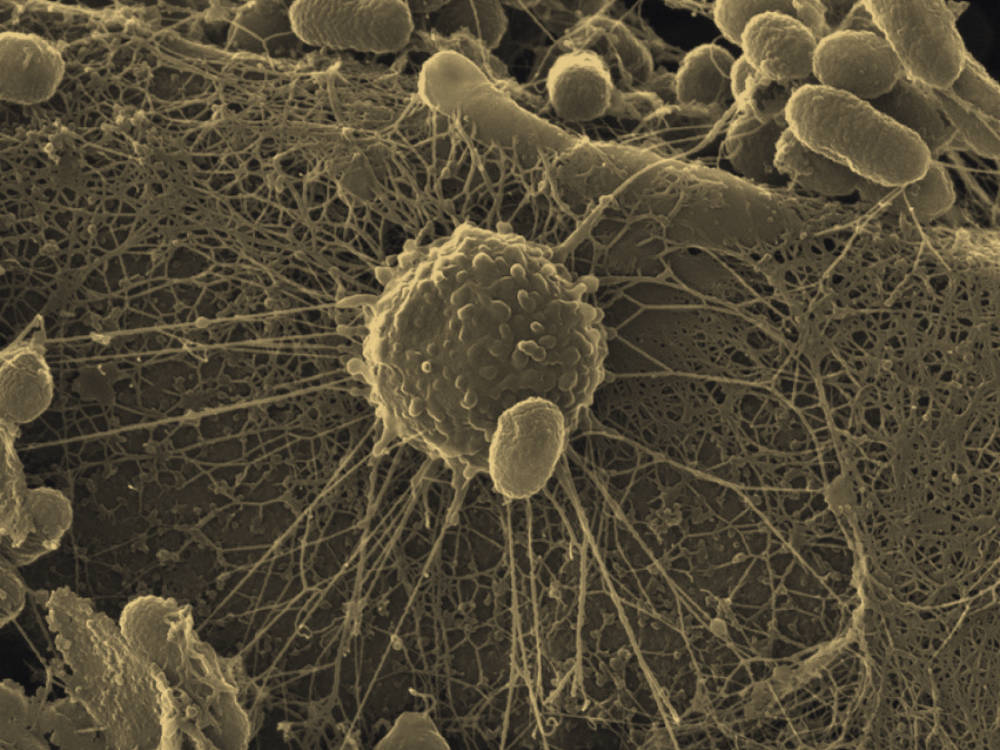
One last thing before we climb further down the hole, because the word "earth" is radioactive in 2026. A cosmology in which the whole precedes and rules the parts cannot imagine rule from beneath. It can only ever imagine a better sun. That includes the nativist, blood-and-soil version that Bruno Latour, whose Down to Earth we leaned on in part two, filed under his "Local" attractor12: the retreat behind fence and fatherland, the mirror image of the globalist's flight. The nationalist wants to own the ground, the posture of a sovereign standing on top of it. Hypogearchy is the opposite of that: it is to be ruled by a ground that does not belong to you and never will.
Soil ≠ territory. We will come back to that.
Dust to Dust
Now, I don't want to build the alternative out of books. We already have something way better: we lived it, collectively, for about a year or two, give or take, and then we worked very hard to forget. So let's start from there...
In part three I recorded five things without naming what they had in common. When the parts stopped, the whole stopped: the engine of capitalism, the one Fisher had described as seamlessly occupying the horizon of the thinkable, halted because people stayed home. That's exactly what part two meant by calling capitalism an egregore. Time melted: the clock is a solar instrument, and the moments underneath it, it turned out, have their own duration. Interiority, stillness, slowing down were not a retreat from reality but a descent into where reality is made. Death, perishing, our own finitude, became a part of the household again. And the "spectre of a world which could be free" rose from internal desires, from beneath.
The solar order, where the whole precedes the parts, cannot think a single one of these. So it does what it always does with what it cannot hold: it forgets and carries on. Antimemetic warfare.
The only defense against this trap is an idea, an ontology that is its exact inverse. There is one I want to pull on. It was written, of all things, as a "footnote to Plato":
Alfred North Whitehead, the mathematician who turned to metaphysics late in life, proposed in the 1920s that there are no fixed substances at all, and no eternal forms sitting above the world. There are only moments: each one arises, takes up everything that came before it, becomes something briefly, and perishes into what comes next13. The whole is made by the parts, each moment, and then becomes a part of the next whole. His formula for this is five words long:
The many become one, and are increased by one.13
Whitehead famously called the whole of European philosophy "a series of footnotes to Plato"14, and he meant it as inheritance. Read from down here it is an inversion. Where Plato's forms are above the world with the world participating in them. Whitehead's moments are below everything and everything is made of them. Even his God is not a ruler at the top of a ladder but, in his words, "the fellow-sufferer who understands", luring instead of commanding, whose own nature is formed by the world as it happens15.
I am not claiming that a lockdown proves a metaphysics, but it certainly provided time to read long and boring philosophy texts. And this one in specific stuck with me ever since. In part because it describes a reality in which those five things are not anomalies but the normal case.
Take the old funeral formula and read it as ontology: Ashes to ashes, dust to dust. What perishes is not lost. It is taken up into whatever forms next. Whitehead calls this, without any irony, objective immortality16. And slowing down is simply how you let a moment complete instead of shoving it into the next one. This is where the potential for renewal gets its footing: in the perishing and re-forming of what is already here.
I am aware how easily this turns into mysticism, so let me tether it three times before we go any further:
First, to physics. The plasma physicist Timothy Eastman has spent a career arguing that quantum events are best understood exactly as Whitehead's moments, that context is constitutive instead of mere background, and that the knot we keep failing to untie in the foundations of physics is substance thinking itself17.
Second, to biology. We met Haraway at the bottom of the dig. Here she gives the experience its flesh. "Nothing makes itself", she writes; the word for how things actually come about is sympoiesis, making-with10. Compost, for her, is both a metaphor and a chore. The holobiont we also met down there11 is Whitehead's moment in biology: a self that is an assembly of its parts, remade with every breath. Whitehead has a word for an assembly that holds together over time because its members keep taking each other up: a society18.
We have a word for it too. In part two I called capitalism an egregore, a thing maintained by the repeated behaviour of mere humans. That is a society in Whitehead's sense. So is the human doing the maintaining: a we of cells, microbes and perished moments that feel their way into an I every morning, and could stop. It is the same mechanism at every scale, and it only ever runs in one direction. Capital is sustained by people, people by their cells, cells by their moments. Nothing above makes anything below. The ladder was upside down the whole time.
Third, to dust, and to the horror register this series has carried since the first mention of the CCRU. Negarestani's dust is the tellurian agent that gets in everywhere. His oil is perished life returning as power. His earth is complicit with what rots inside it9. Dust to dust, in his hands, is a threat: perishing is not the end of agency but its redistribution. The dead are not gone, they are very, very busy.
I have a jar of earth from my grandparents' graves on a shelf, collected during Parentalia in 2019 with a Saturn coin on top to serve as a portal. I have always thought of the coin as the technology and the dirt as the address. Now I understand it was actually the other way round!

What would a magic look like that thinks this way rather than the solar way? That is a question for after this series, and I am only going to open the cave entrance. But I think you'll dig the gist of it: enough with emanations descending from the planets, how about occasions arising from the ground. Not illumination, but adjustment to the dark. More attention to the dead, the dust, the microbial and the slow, as the places where the whole is actually being remade. Slowing down so the present can complete. Let's do more listening for what bubbles up, because in a world made of moments the new seeps in from below. An egregore is not changed from above. It changes when its hosts do something it did not expect.
In a sense the pandemic was an involuntary rehearsal of exactly this orientation. It was viral cells that started it after all, reminding us of who's actually running things around here.
Soil Horizons
All of which brings us back, as the red thread demands, to Mark Fisher. I guess I owe him four answers.
Acid. In part one I described Fisher's acid as shorthand for any experience that dissolves the barriers imposed by commodified individualism19. He meant the psychedelic, even when he insisted he did not need the drug. I want to take the word at its pH value instead. Acid is the agent in the soil, in the gut, in the rain that takes things apart and returns them to circulation. It works slowly, by contact, through corrosion. A "trip" may undo the self for an afternoon, but by Monday its boundaries are back in place. The earth offers no such escape. It has been working on everything, including us, all along.
Communism. Fisher wanted "a new kind of collective agent, a new possibility of speaking in the first person plural"20. "The many become one, and are increased by one" is a first person plural, written into the structure of every moment. The holobiont is always a we before it is ever an egregoric I. Communism expanded downward is the solidarity of parts forming wholes, and it includes everything we found squirming at the bottom of the dig.
The future. "Our desire is for the future", Fisher wrote, "and it comes from the future." But read the next sentence again: "it is for us to construct this future, even as – at another level – it is already constructing us."20 That second clause is pure process. He was this close...
Haunting. My complaint in part one was that Acid Communism, for all its invocation of the weird, was oddly unhaunted, able to reach the numinous only through the psychedelic lens. I can now say why: a materialism of substances has no room for anything it cannot point at, so the strange has to be smuggled in as experience, which means a trip. A process ontology has no such problem. Every moment is made of what it takes up from others, and the others are not all visible, not all human, and not all alive: the perished, the microbial, the ancient ones moving through the holes in the earth, the societies above that we feed, and whatever else is participating in the assembly that calls itself I. A self built this way is haunted by construction. The numinous is the company you have already been keeping.
Fisher kept communism under protest and said the real name would appear and we would recognise it. I'm throwing hypogearchy on the table: the principle that whatever is worth building is grown from beneath, by everyone and everything already down there, and that the way to it is a descent, not an ascent.
That is the ontology. All fancy words. An ontology does not tell you what to do on a Tuesday.
Stay tuned for the final part, in which we get our hands dirty: the earthly, emancipatory rites of magic promised in the very first paragraphs of this series.
-
Wiktionary: ἀρχή. The same root gives us archon, the ruler, and archaic, that which was there first. ↩
-
Nick Land (1993). Machinic Desire, Fanged Noumena: Collected Writings 1987-2007, p. 338. Publisher Link ↩
-
Haraway, Donna. "Situated Knowledges: The Science Question in Feminism and the Privilege of Partial Perspective." Feminist Studies 14.3 (1988): 575-599. ↩
-
Galloway, Alexander R. "Brometheanism." b2o: boundary 2 online, June 2017. Link ↩
-
Plotinus, Enneads V.1 and V.2, on the One and on the procession of all things from it. The MacKenna translation is in the public domain. ↩
-
Plato, Republic, 507b-509c (the analogy of the sun) and 514a-520a (the allegory of the cave). ↩
-
Negarestani, Reza. Cyclonopedia: Complicity with Anonymous Materials. re.press, 2008. Publisher Link ↩↩
-
Haraway, Donna J. Staying with the Trouble: Making Kin in the Chthulucene. Duke University Press, 2016. ↩↩
-
Gilbert, Scott F., Jan Sapp, and Alfred I. Tauber. "A Symbiotic View of Life: We Have Never Been Individuals." The Quarterly Review of Biology 87.4 (2012): 325-341. ↩↩
-
Latour, Bruno. Down to earth: Politics in the new climatic regime. John Wiley & Sons, 2018. Publisher Link ↩
-
Whitehead, Alfred North. Process and Reality: An Essay in Cosmology. Corrected edition, eds. Griffin and Sherburne. Free Press, 1978, p. 21. ↩↩
-
"The safest general characterization of the European philosophical tradition is that it consists of a series of footnotes to Plato." Process and Reality, p. 39. ↩
-
Process and Reality, Part V, Chapter II, p. 351: God's consequent nature as formed by the world, and "the great companion – the fellow-sufferer who understands". ↩
-
Process and Reality, p. xiii and passim: a perished occasion lives on as a component of every occasion that takes it up. ↩
-
Eastman, Timothy E. Untying the Gordian Knot: Process, Reality, and Context. Lexington Books, 2020. ↩
-
Process and Reality, p. 34: a nexus is any set of occasions bound together by taking each other up; a society is a nexus that keeps handing a shared character down to its newest members. A stone is a society. So is a person. So is an egregore. So is a god. ↩
-
Mark Fisher, For now, our desire is nameless, The European, May 20th 2014, Web Archive ↩↩↩
-
Bataille, Georges. The Accursed Share: An Essay on General Economy, Vol. 1: Consumption. Zone Books, 1988, p. 21. ↩
Comments